How to Research a Company Online Without Confusing Signals for Facts
A fair, evidence-aware framework for using public information to understand a company, verify claims, and preserve uncertainty.
Public company research is useful for vendor conversations, journalism, customer safety, and organizational due diligence. It can also become unfair when a collection of incomplete online signals is treated as a verdict. The disciplined approach is to define a legitimate question, select relevant source types, check independence and timing, and explain what remains unknown.
Use source types for the claims they can support
An official website may establish what a company publicly says about itself. A public filing-style record may support a date or legal entity detail. A news article may report an event. No one source type establishes every claim, and a missing page can reflect many ordinary reasons.
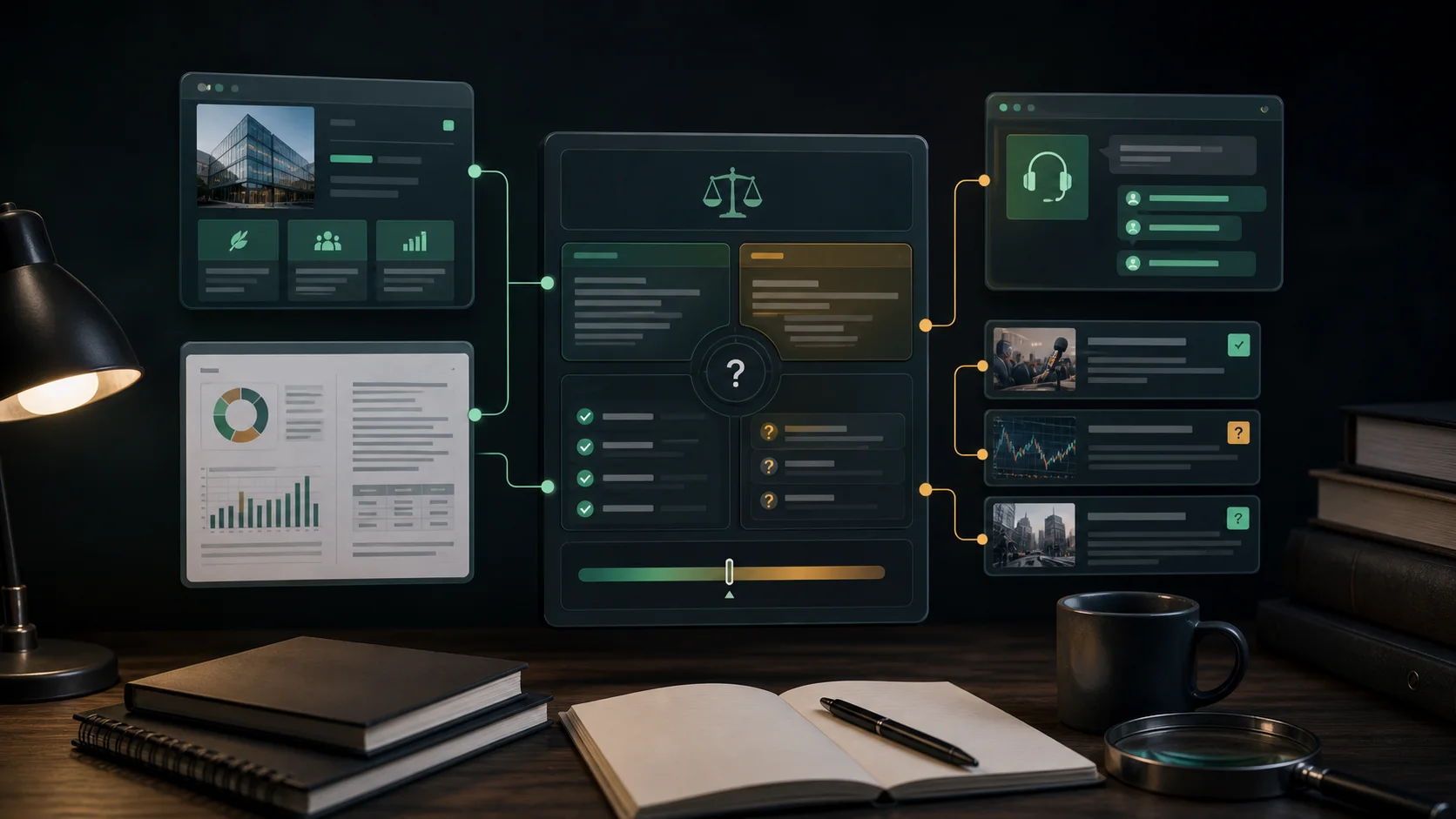
Check relevance, recency, and independence
| Check | Why it matters |
|---|---|
| Relevance | A source should relate to the specific company and decision, not merely a similar name. |
| Recency | Old profiles, staff pages, and contact details can outlive reality. |
| Independence | Repeated copies of one claim remain one evidence stream. |
| Context | A statement may describe a historic, regional, or limited situation. |
Make confidence visible
Write down observed fact, inference, alternative explanation, and confidence. A public contact page that links to a domain supports that public association on the date observed. It does not prove financial health, security maturity, or the identity of every employee.

Responsible company research produces a short, fair report with direct links and clear limitations. If a finding could affect a contract, customer, employee, or reputation, route it to the accountable owner for further authorized review.
// USEFUL_INTEL?
Signal that this research note was useful.