Quick Answer: Is Email OSINT Legal?
Email OSINT can be lawful when it uses information that is legally accessible, serves a legitimate and proportionate purpose, and is handled responsibly. It is not automatically lawful merely because an email address is visible on a public page. The answer depends on what data is collected, where it came from, how it was accessed, why it is used, whose data is involved, what jurisdiction applies, and what happens after the lookup.
Searching a public company contact page for one security mailbox is a very different activity from building a database of millions of identified people, linking their email addresses to sensitive details, and publishing the result. Likewise, looking at a publicly indexed page is different from bypassing a login, using stolen credentials, or accessing a private account. Finding ≠ processing ≠ publishing.
What Counts as Email OSINT?
Email OSINT is the gathering and analysis of information associated with an email address from legally accessible sources: search results, public websites, developer profiles, documents, directories, authorized security tools, and reputable exposure-notification services. A public webpage, a restricted database, an enrichment API, a leaked dataset, and a private mailbox are not equivalent sources. Record provenance and access conditions so observed facts stay separate from vendor claims and analyst inference.
Publicly Accessible Does Not Mean Legally Unrestricted
An address may be visible in a company directory, PDF, GitHub commit, or public profile. That answers an access question: a visitor could view the page without a bypass. It does not settle collection, profiling, retention, sharing, marketing, or publication. An employer may publish [email protected] for vulnerability reports without inviting mass harvesting or unrelated enrichment.
GitHub documents email-privacy settings and no-reply addresses, a reminder that public development activity has context and attribution limits. Accessibility is not a blanket permission for every downstream use. Terms, privacy obligations, anti-harassment rules, contracts, and sector rules can still apply.
Is an Email Address Personal Data?
Under the EU GDPR, personal data is information relating to an identified or identifiable natural person. The European Commission explains that information which identifies a person when combined can also be personal data. A personal address such as [email protected] often does so directly, and a work address assigned to a named employee can as well.
Role addresses need context. [email protected] may describe a function, but can become identifying when linked to an individual. The ICO notes that a corporate address relating to a particular employee is personal information. If an address or surrounding record is personal data, its collection, correlation, storage, and disclosure can be processing; public sourcing does not remove the data-life-cycle question.
Do You Need Consent for Email OSINT?
Consent is important, but it is not the only question or always the required answer. In an EU GDPR context, Article 6 lists consent, contractual necessity, legal obligation, vital interests, public task, and legitimate interests as possible lawful bases. The appropriate basis, if any, depends on the facts; this is not a menu that automatically validates a preferred outcome.
Consent can be relevant or required, especially for some communications and data uses. Another basis, where available, does not remove purpose limitation, necessity, minimization, transparency, security, retention, or individual-rights questions.
| Concept | What it means | Common misunderstanding |
|---|---|---|
| Consent | Valid permission from an individual where it is applicable. | Consent is always required for every OSINT activity. |
| Lawful basis | A legal justification for processing personal data in a regime that requires one. | Any business reason is automatically lawful. |
| Public availability | Data can be accessed from a public source. | Public means unrestricted collection and reuse. |
| Authorization | Permission to access a system, account, dataset, or assessment scope. | Knowing an email authorizes access to its account. |
| Terms of service | Platform or provider rules that can govern use of a service or API. | If conduct is not criminal, terms do not matter. |
Does Legitimate Interest Make Email OSINT Legal?
No label does that by itself. Security and fraud prevention can involve a real interest, but legitimate interests is not a permission slip for unlimited collection. The ICO describes a three-part assessment: identify a legitimate purpose, show necessity, and balance it against the persons rights and freedoms. Reasonable expectations and likely impact matter.
A narrowly authorized phishing investigation may have a clearer purpose and smaller need than silent marketing-list enrichment. If a less intrusive method can reach the outcome, use it. Document purpose, scope, safeguards, and limits. UK readers should use current ICO and Data Protection Act 2018 guidance, not assume an EU summary is the whole answer.
Why the Scope of an Email OSINT Investigation Matters
Scale changes both privacy impact and operational risk. A one-time self-audit, an authorized investigation of a small incident, and a large enrichment program may all be called email OSINT. They do not create the same legal, ethical, or governance questions.
| Scenario | Typical risk level | Main questions |
|---|---|---|
| Searching your own email | Lower | What is publicly exposed, inaccurate, or outdated? |
| Checking a company security mailbox | Lower–Moderate | Are you authorized and is the work relevant to security? |
| Approved employee incident investigation | Context-dependent | Scope, policy, necessity, privacy, and retention. |
| Bulk-enriching customer emails | Higher | Lawful basis, transparency, source provenance, provider terms, and scale. |
| Checking breach exposure defensively | Context-dependent | Source, authorization, handling, and disclosure limits. |
| Publishing personal email data | Higher | Necessity, harm, jurisdiction, and a basis for disclosure. |
| Bypassing account access controls | Very high / outside normal OSINT | Authorization and computer-access law. |
Risk is not a legal verdict. It is a prompt to slow down. The broader the population, the more attributes collected, the more sensitive the correlation, and the longer the retention period, the stronger the case for documented governance and specialist review.
What Determines Whether Email OSINT Is Lawful?
A useful legal-awareness model checks the whole activity rather than just the query. The ten factors below help turn an abstract question into a reviewable decision. They are not an official legal test, and they do not replace local legal analysis.
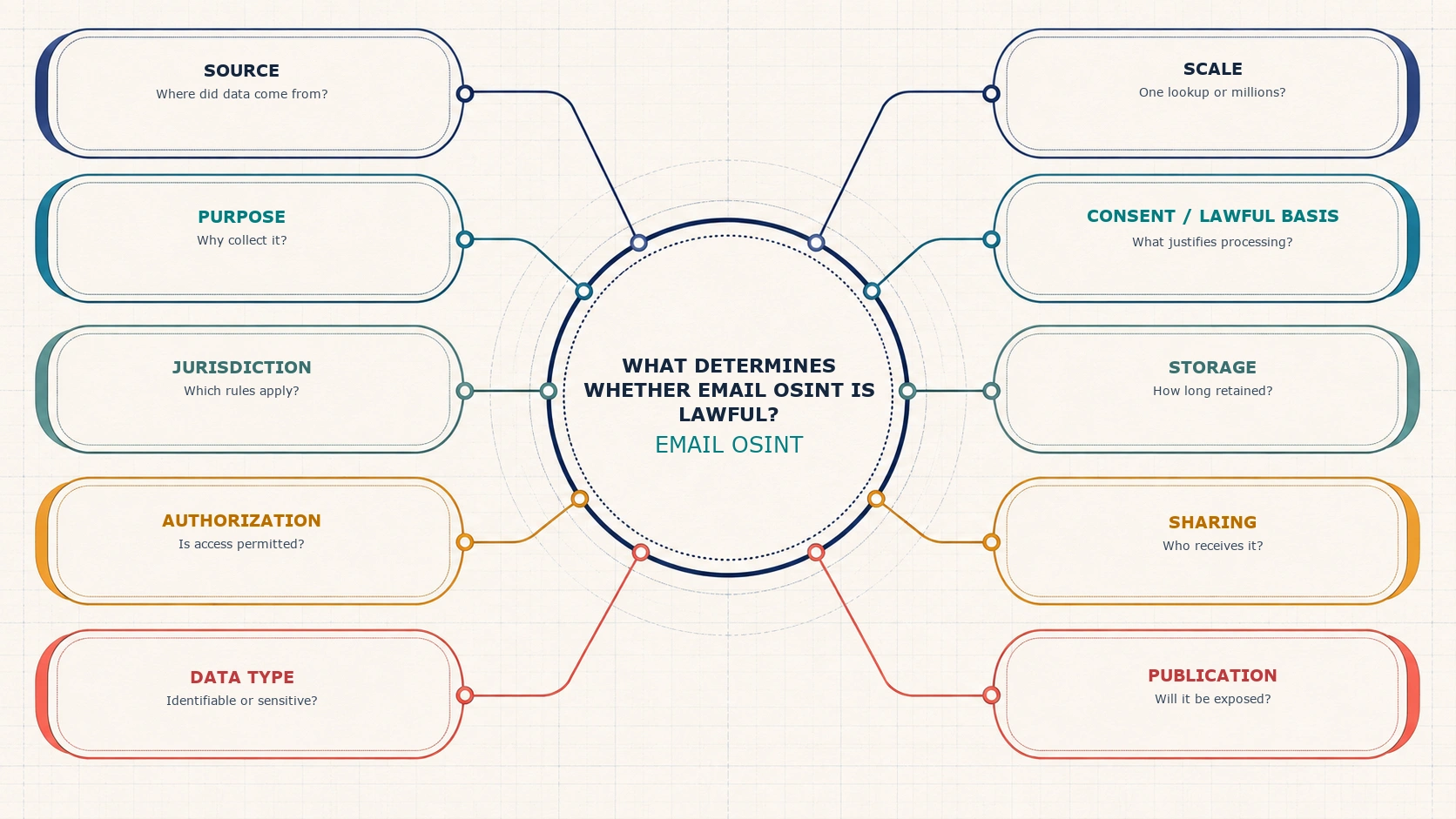
- Source: Where did the data originate, and was it genuinely public or properly authorized?
- Purpose: What specific outcome justifies the lookup?
- Jurisdiction: Which laws and regulators may apply to the people, organization, source, and processing location?
- Authorization: Are you permitted to access the system, assessment scope, or organizational data involved?
- Data type: Does the address identify a person or connect to sensitive categories of information?
- Scale: Is this one targeted check or an automated population-level operation?
- Basis and safeguards: Is there consent, another potentially relevant basis, and evidence of necessity and proportionality?
- Storage, sharing, and publication: Who can access the result, how long is it retained, and will it be disclosed beyond the initial purpose?
The Purpose of the Investigation Matters
Purpose does not make an unlawful method lawful. It does explain why a given amount of data may be necessary and proportionate. An authorized team investigating an impersonation campaign may need public references to a company domain and a small address set. A private dispute does not automatically justify collecting family details, home information, old profiles, and unrelated accounts.
Where the Email Data Comes From Matters
Public websites and search engines
Company pages, biographies, documents, and directories may be lower-risk starting points. Still check why the page published the address, whether it is current, whether automated access is addressed, and whether reuse matches context. A search result is a pointer, not a universal license.
Public code repositories
Developer records can expose commit identities, profile information, and emails in varying ways. GitHub documents commit-email behavior and a no-reply option. Treat a commit address as a contextual artifact: it may be historical, locally configured, shared, or protected. Do not use it alone as identity proof.
Commercial data providers and lookup APIs
A provider claim does not transfer all responsibility downstream. Ask how data was obtained, whether the contract permits your purpose, where queries are stored, whether data crosses borders, and how correction or deletion is handled. Querying an email can disclose it to the provider; review its privacy notice, security, retention, and terms.
Why Breach Data Requires Extra Caution
Checking an address in a breach-notification service is not the same as acquiring a leaked database, redistributing credentials, attempting access, or exploiting exposed data. Use reputable defensive services and stay inside their authorization model. Have I Been Pwned describes verification for domain-wide searches, restricts sensitive-breach results to verified owners, and warns that not found is not proof of no compromise. An exposure signal can support account hardening and incident response; it does not authorize credential testing, recovery abuse, or public exposure.
OSINT Stops Being Open Source When You Bypass Access Controls
Knowing an email address does not authorize access to its account. Login bypass, stolen credentials, unauthorized account access, private API abuse, and access-control evasion are beyond normal open-source research. In the United States, computer-access questions can involve federal and state rules; 18 U.S.C. § 1030 addresses specified unauthorized-access conduct. A terms disagreement is not automatically a criminal case, and a public email is not an authorization token. Stop and seek advice for a real access dispute.
Terms of Service and the Law Are Not the Same Thing
A platform term is not automatically a criminal statute, but it can lead to revoked access, suspension, contractual consequences, rate limits, disputes, or provider action. A public page does not necessarily permit high-volume collection. Assess law, contract, organizational policy, and likely impact separately.
Email OSINT Under the GDPR: The Basic Questions
When GDPR applies and an address relates to an identifiable person, consider lawfulness, fairness and transparency; purpose limitation; minimization; accuracy; storage limitation; security; and accountability before a lookup becomes a dataset. The exact obligations, territorial reach, exemptions, and information duties are context-dependent.
Ask what purpose is pursued, what minimum data is needed, whether it is current enough, who needs access, and whether retention is defensible. Extra caution is needed if correlations reveal health, political views, religion, trade-union membership, sexual orientation, biometric identifiers, or criminal allegations. Do not seek or combine such material by default.
Email OSINT in the United Kingdom
UK work should be assessed under the current UK GDPR, the Data Protection Act 2018, and relevant rules such as PECR for electronic marketing. The ICO is the practical first stop for current guidance. Its lawful-basis pages explain that a valid basis is required for handling personal information and that legitimate interests must be justified with purpose, necessity, and balancing analysis. Its guidance also makes clear that a corporate address used by an identifiable employee can be personal information.
Marketing is a separate question from finding an address. The ICO guidance on electronic mail marketing says marketing emails or texts to individual subscribers generally require specific consent unless the limited soft opt-in applies. There are different rules for corporate bodies and different treatment for sole traders and some partnerships. This is exactly why collection legality does not equal permission to market.
Email OSINT in the United States
The United States does not have one universal Email OSINT law. The answer can involve federal and state privacy law, consumer-protection rules, sector-specific requirements, computer-access law, anti-harassment or anti-stalking law, employment rules, and contract. The facts and state connections matter, so a general online statement that a lookup is legal in the United States should not be treated as nationwide advice.
California illustrates the downstream-use point. The California Privacy Protection Agency explains that the CCPA gives consumers rights over personal information covered businesses collect and requires information about collection, use, and retention. The CPPA also administers California data-broker rules, including current registration and deletion-mechanism requirements for qualifying brokers. This does not create a blanket ban on all research involving email addresses. It does show why collection at scale, selling, sharing, and operating without a direct consumer relationship can create a different compliance landscape from a single security lookup.
For commercial email, the FTC explains that CAN-SPAM governs commercial messages and covers more than bulk mailing, including business-to-business email. A team that lawfully discovers an address still needs a separate review of marketing requirements, accurate headers, opt-out handling, and other applicable rules.
Why Jurisdiction Changes the Answer
A cross-border email investigation can touch more than one place: where the investigator works, where the person is located, where a provider operates, where the data is stored, and where a report is published. Privacy, data-localization, employment, marketing, scraping, harassment, and cybersecurity rules can differ across those connections. Do not import a narrow United States or European answer into another jurisdiction without checking the local rule and the organizational role.
Are Business Email Addresses Different From Personal Emails?
They can be different in context, but not through a universal shortcut. [email protected] is more likely to signal a business function than [email protected]. [email protected] can point directly to an employee. A sole trader address may be closer to an individual address than a large company mailbox. Purpose and identifiability determine more than the domain suffix does.
Use the least intrusive interpretation that fits the task. If the goal is to report a security issue to a company, a role mailbox may be sufficient. There is no need to pivot into private accounts, family information, or unrelated personal profiles.
Email OSINT in Authorized Security Investigations
Authorized corporate work is often easier to scope than a private investigation. Examples include phishing exposure, employee impersonation, leaked corporate accounts, external attack-surface review, and threat intelligence. Written authorization, a defined incident, and a narrow target set all help establish why a lookup is necessary.
Authorization is not the finish line. Teams should still follow company policy, minimize irrelevant collection, secure evidence, control who can access the results, document third-party services, set retention rules, and observe local employment and privacy requirements. A security finding should describe what was observed and avoid unnecessary personal narrative.
Checking Your Own Email Footprint Is the Lowest-Risk Use Case
Self-OSINT is a practical defensive use of email research. Search your own address for public profile references, old forum posts, conference documents, developer artifacts, and exposure notifications from reputable services. Use the result to remove outdated public material where possible, improve account security, change weak or reused credentials, enable multifactor authentication, and review privacy settings.
Journalism and Research Need Their Own Ethical Analysis
Journalists and researchers may work with public-interest questions, institutional review, editorial standards, or research safeguards. None of those labels is a universal exemption. Verification, necessity, proportionality, harm reduction, source protection, and data minimization remain important. A public interest may support asking a hard question, but it does not turn excessive collection or avoidable disclosure into responsible practice.
From Public Data to Higher-Risk Processing
Legal and privacy risk often grows after the initial search. Viewing a public page, collecting a result into a structured file, correlating it with other identifiers, storing it, sharing it, and publishing a profile are distinct events. Each step can add people, attributes, recipients, persistence, and impact.
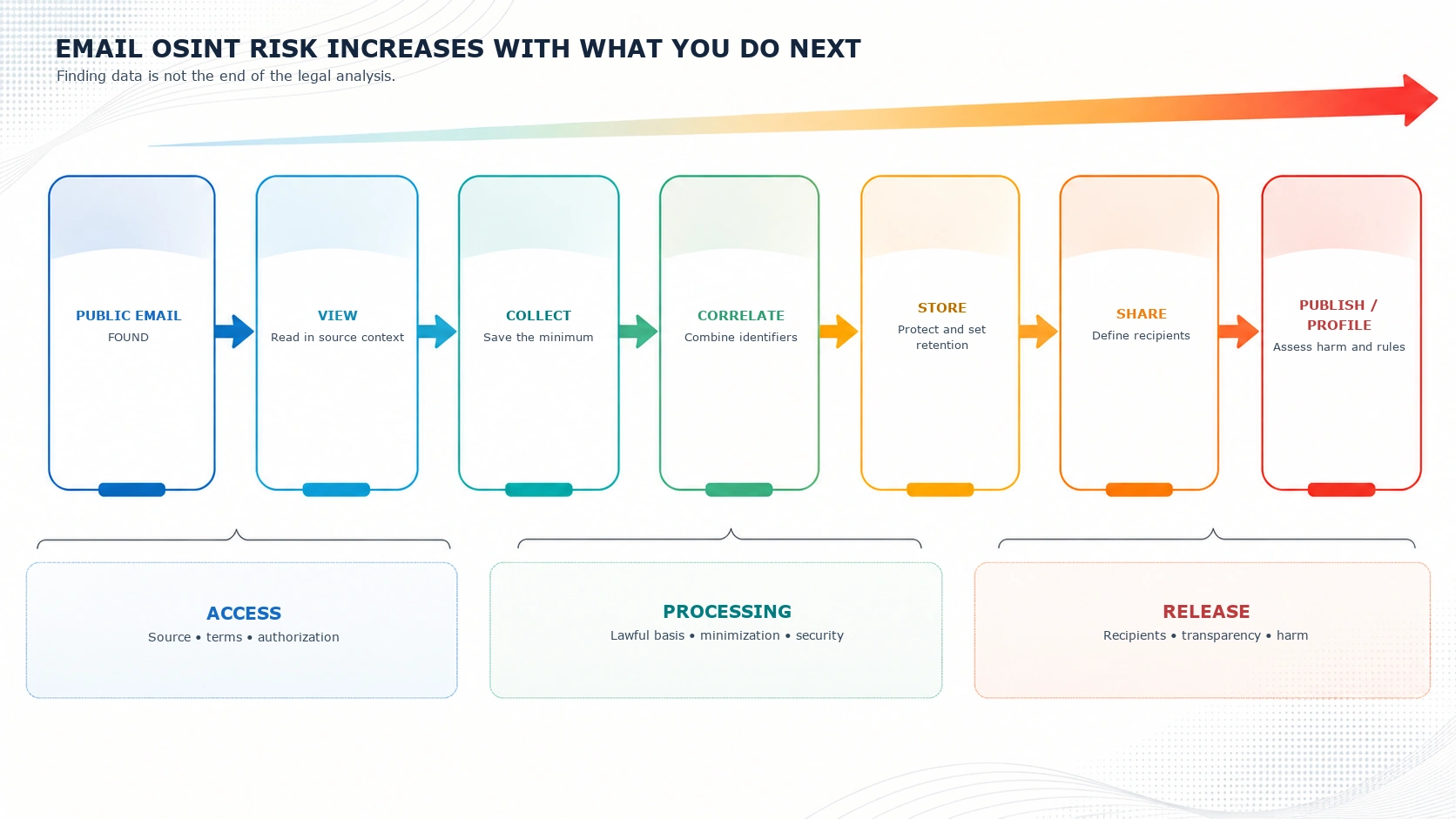
This model is useful for product teams as well as investigators. A lookup tool that merely displays a public source has different responsibilities from a service that keeps a long-lived enriched profile, exposes it through an API, or supplies it to customers. Build controls at the point where data moves from discovery into a reusable asset.
Finding Information Is Different From Publishing It
A researcher may locate an address in a public document and retain a minimal note for an authorized, time-bounded case. Publicly republishing that address with allegations, personal details, or a contact map is a different action with potentially greater privacy, reputational, and harassment impact. Publication needs its own necessity and harm analysis. Do not confuse the ability to observe a source with permission to amplify it.
Collect Only What You Actually Need
Data minimization is a privacy safeguard and a practical security control. NIST defines minimization as limiting the creation, collection, use, processing, storage, maintenance, dissemination, or disclosure of personally identifiable information to activity directly relevant and necessary to an authorized purpose, and retaining it only as long as needed. This fits an email OSINT workflow well.
If the question is whether a corporate address is publicly exposed, the necessary evidence may be a URL, capture date, and limited context. It may not require collecting the owners family information, home address, personal social accounts, or every historical alias. Scope discipline reduces error, breach impact, and the chance that a useful security task drifts into personal surveillance.
What Happens After You Collect the Data?
Many privacy failures happen after discovery. An email OSINT file may contain addresses, usernames, employers, profile links, exposure notes, timestamps, and analyst conclusions. Treat it as sensitive operational data: restrict access, apply appropriate encryption and logging, separate raw evidence from inferences, set a retention period, and define deletion and backup handling.
Third-party tools add another layer. When an analyst submits an address to a lookup platform or API, the provider may receive, log, retain, enrich, or transfer the query. Review its privacy notice, data-processing terms, account controls, data locations, and breach-notification practices. Prefer providers whose role and limits are clear. Do not assume a vendor name removes the need for organizational accountability.
Why Automation Changes the Risk
Automation is not automatically unlawful. It can support authorized exposure monitoring, standardized incident response, and repeatable security checks. But manually reviewing one address and automatically enriching 100,000 addresses differ in scale, platform load, privacy impact, source dependency, and governance needs. API limits and access restrictions are signals to respect, not obstacles to defeat.
Before automating, document the target population, authority, fields collected, sources, purpose, expected false-positive handling, rate limits, retention, recipient groups, and a stop condition. Test with the smallest feasible sample. A program that silently accumulates personal profiles creates more risk than a controlled process that records only what a defined security question needs.
Email OSINT and Email Marketing Are Not the Same Legal Question
A lawfully found email address is not automatically a marketing permission. Marketing communications can have their own consent, opt-out, transparency, subscriber-type, and anti-spam requirements. The FTC CAN-SPAM guidance and the ICO PECR guidance illustrate how rules can differ by jurisdiction and message type. Review the communication law separately from the research source before contacting anyone.
When Email OSINT Becomes Legally or Ethically Riskier
Risk typically rises with large-scale automated collection, enrichment with sensitive personal information, indefinite storage, sales or sharing of profiles, publication of personal contact details, targeting of vulnerable people, use of stolen credentials, access-control bypass, harassment, stalking, discrimination, or investigation of people unrelated to a legitimate purpose. The fact that some fragments came from public pages does not neutralize the combined impact.
Children and vulnerable people warrant extra caution. Avoid personal investigations of minors or people at risk unless there is a clear lawful and safeguarding context, proper authority, and an appropriate professional process. The safer default is to minimize collection and avoid publication.
Legal Does Not Always Mean Responsible
A practice can avoid an obvious legal prohibition and still be unnecessary, disproportionate, invasive, or unsafe. Ethical practice asks what should be collected, not only what can be found.
A Practical Checklist Before Running Email OSINT
SCOPE is an editorial memory aid, not a formal legal test. Use it to make a privacy conversation happen before the first query becomes a persistent record.
- S — Source: Where does the information come from? Is it genuinely public or properly authorized?
- C — Context: Why is this address being investigated? What is the legitimate and specific purpose?
- O — Only what you need: What minimum fields, people, and sources are relevant?
- P — Permission and privacy: Is authorization required? Is consent relevant? Could another lawful basis apply, and what safeguards are needed?
- E — Exit and erasure: Who can access the result, how long is it retained, and when will it be deleted?
Email OSINT Risk Matrix
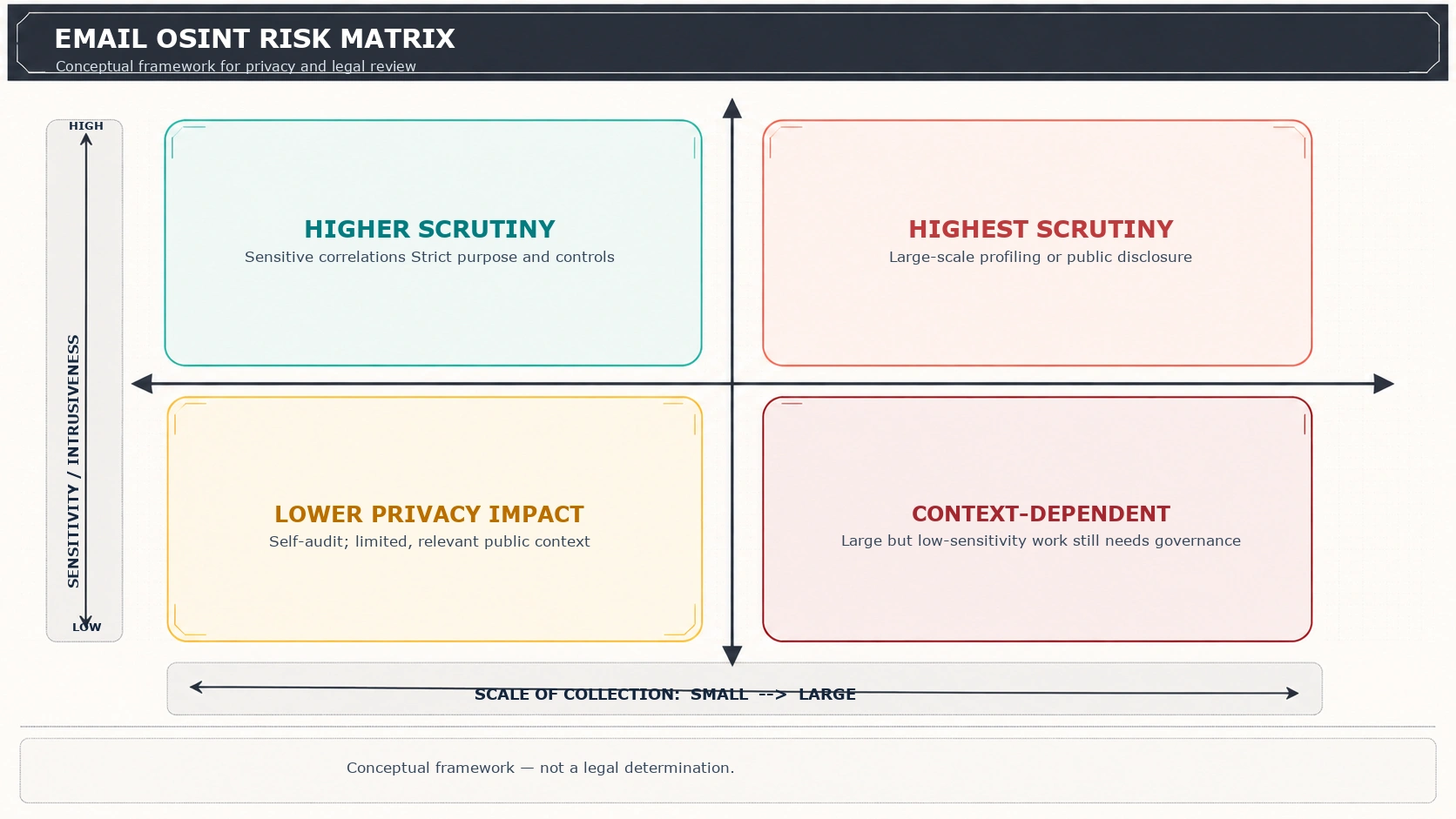
The matrix below does not classify activities as legal or illegal. It helps identify situations that need more review. Higher sensitivity, broader collection, more intrusive correlation, and wider disclosure generally justify more careful assessment, stronger controls, and professional advice where consequences are significant.
Three Fictional Scenarios
1. Defensive self-audit
Alex searches an address they control for old forum profiles, GitHub references, a conference PDF, and breach exposure through a reputable notification service. The purpose is defensive: remove outdated exposure, secure accounts, and improve privacy settings. The work is narrow, transparent to the person affected, and avoids redistributing the findings.
2. Authorized corporate investigation
A company security team investigates an impersonation campaign that uses employee names. Within written scope, it checks public references to company addresses and phishing infrastructure. The team limits collection to relevant corporate data, records source URLs and dates, controls access to the case file, and deletes unnecessary working notes after the incident process. That is materially different from a private employee dossier.
3. Crossing the line
During a personal dispute, a user bulk-collects a target address, relatives, home information, social accounts, and historic public records, then publishes a profile. Even if some fragments were publicly visible, the purpose, aggregation, correlation, and publication create a far more intrusive scenario with potential privacy, harassment, and legal consequences. Stop rather than escalating.
What Email OSINT Does Not Give You Permission to Do
- Log into, reset, or access another persons account.
- Intercept messages or access private mailboxes.
- Use stolen credentials or bypass authentication.
- Impersonate an account owner or evade platform security controls.
- Harass, stalk, discriminate against, or dox a person.
- Publish sensitive private information without a compelling and lawful basis.
- Treat a breach-exposure signal as permission to test credentials against real services.
Watch: Personal Data and Privacy in Plain Language
The European Commission video GDPR: WHO DOES WHAT WITH YOUR PERSONAL DATA? is a short, official introduction to how personal-data roles and rights fit together. It is not an email OSINT tutorial, but it provides useful context for the question this article raises: data handling has consequences beyond the first search result.
Use it as a reminder to map roles and actions. The person who collects a result, the service that processes a query, the organization that decides the purpose, and the recipient of a report can all have different responsibilities.
Common Misconceptions About Email OSINT and the Law
- It is on Google, so I can do anything with it. Search visibility does not answer reuse, marketing, retention, or publication questions.
- If it is public, GDPR does not apply. Public availability does not remove the possibility that information is personal data or that processing principles apply.
- You always need consent. Consent is not the only lawful basis in systems such as the GDPR, but other bases have conditions and limits.
- You never need consent for public data. Communications and specific uses can create separate consent requirements.
- Using an OSINT tool makes the activity legal. A tool does not supply authority, purpose, or a lawful basis.
- Paying a provider makes data safe to use. Provider provenance, contracts, privacy, and downstream use still require review.
- A company email is never personal information. A named employee address can relate to an identifiable person.
- Leak data online is public-domain data. Exposure, acquisition, handling, exploitation, and republication are distinct questions.
- Finding an address means I can market to it. Marketing law and opt-out rules are separate from discovery.
Frequently Asked Questions About Email OSINT and the Law
1. Is it legal to search someones email address online?
Often a public-page search can be lawful, but the answer depends on source, purpose, jurisdiction, scale, and later use. Do not turn one lookup into unrestricted profiling or publication.
2. Is reverse email lookup legal?
It is not a single legal activity. A lawful answer requires examining the provider, data source, access method, applicable privacy rules, and intended use.
3. Do I need consent to perform email OSINT?
Not always, but consent may be relevant or required in some circumstances. Where personal data law applies, another lawful basis may be considered only with its conditions and safeguards.
4. Is an email address personal data under GDPR?
It can be, when it relates to an identified or identifiable natural person. A named personal or work address often does; a purely functional mailbox needs contextual analysis.
5. Is it legal to search an email in breach databases?
Defensive exposure checking can be appropriate, particularly for your own address or authorized organizational assets. Do not use breach results for credential abuse, account access, or public shaming.
6. Can I use public email addresses for marketing?
Not automatically. Marketing messages can be subject to separate anti-spam, consent, opt-out, and privacy rules.
7. Is it legal to automate email OSINT?
Automation changes scale and risk. Confirm authorization, platform rules, source terms, privacy obligations, data minimization, retention, and false-positive controls before running it.
8. Can companies perform email OSINT on employees?
Authorized incident response can have a legitimate security purpose, but it should be tightly scoped, policy-led, privacy-aware, and consistent with applicable employment and data-protection law.
9. Is searching your own email footprint legal?
It is generally the lowest-risk defensive use case. Use reputable services, improve account security, and minimize unnecessary sharing.
10. Does public information lose privacy protection?
No. Public availability and privacy protection are different concepts. Context, identifiability, processing, and jurisdiction still matter.
11. Is using an email lookup API legal?
It depends on the API terms, source provenance, authorization, what the provider logs, and how you use and retain the result. The query itself may disclose an address to the provider.
12. When should I speak to a lawyer or compliance team?
Seek review before large-scale collection, sensitive-data correlation, employee monitoring, cross-border work, vendor deployment, public reporting, marketing use, or any activity that could materially affect a person.
Sources and Further Reading
- EUR-Lex: General Data Protection Regulation, Regulation (EU) 2016/679
- European Commission: Application of the GDPR and the definition of personal data
- European Commission: Principles of the GDPR
- ICO: A guide to lawful basis
- ICO: Legitimate interests
- ICO: What is personal data?
- ICO: Electronic mail marketing under PECR
- UK legislation: Data Protection Act 2018
- California Privacy Protection Agency: CCPA FAQs
- California Privacy Protection Agency: Information for data brokers
- Federal Trade Commission: CAN-SPAM Act compliance guide
- United States Code: 18 U.S.C. § 1030
- GitHub Docs: Email addresses reference
- Have I Been Pwned: Frequently asked questions
- NIST CSRC: Minimization
- EU Justice and Consumers: GDPR: WHO DOES WHAT WITH YOUR PERSONAL DATA?