Username OSINT tools are useful for discovering candidate public profiles, but there is no single meaningful “accuracy percentage” unless it comes from a defined, reproducible benchmark. A tool can be technically correct that a profile exists and still be completely wrong about who owns it. That distinction is the starting point for interpreting results from Sherlock, Maigret, WhatsMyName-based clients, SpiderFoot modules, and similar username lookup workflows.
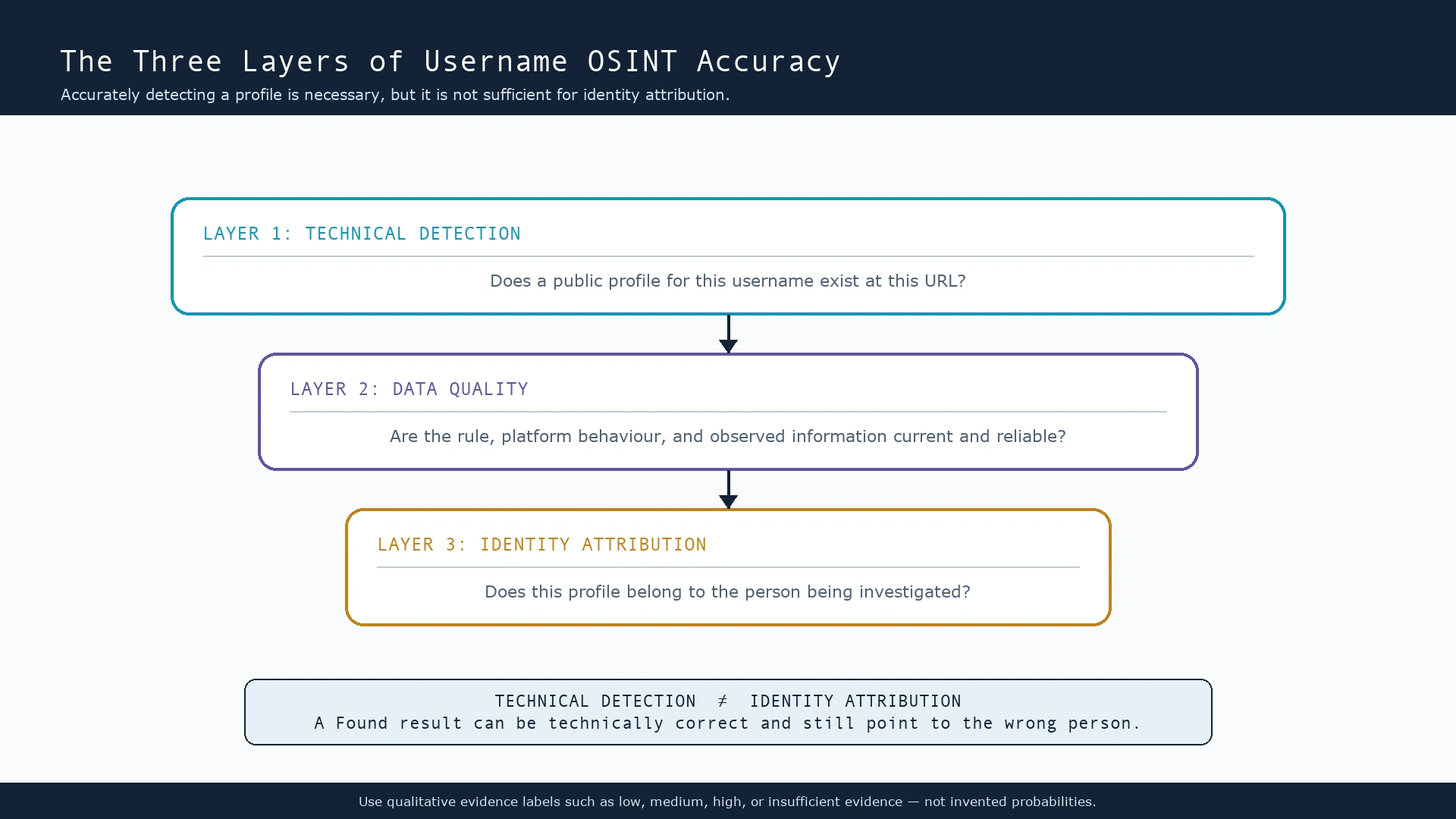
Two questions are routinely collapsed into one: Did the tool correctly detect that a profile exists? and does that profile belong to the person being investigated? The first is a technical detection problem. The second is an identity-attribution problem that usually requires public context, independent evidence, and human judgment. A Found label answers neither question on its own.
Quick Answer: How Accurate Are Username OSINT Tools?
Username OSINT tools can be effective at finding candidate profiles, but result quality varies by site, detection method, rule freshness, network conditions, username uniqueness, and whether the platform currently permits an automated check. The responsible answer is not “Tool X is 95% accurate.” It is: accurate at what, on which sites, with which rules, at what time, and against what ground truth?
| Question | What it actually measures | What it cannot prove alone |
|---|---|---|
| Was the profile detected? | Profile-existence detection for a specific username and URL | That the profile belongs to a particular person |
| Was a profile missed? | Potential false-negative behaviour, coverage limits, or an indeterminate request | That the account never existed |
| Did several tools agree? | Agreement on one or more public signals | Independent identity confirmation |
| Does a tool list many sites? | Potential coverage, under that project own definition | Precision, recall, current rule quality, or attribution accuracy |
The key rule: a username tool can be technically right about an account existing and still be wrong about the identity behind that account.
What Does “Accuracy” Mean for a Username OSINT Tool?
“Accuracy” can refer to several different things: whether a URL has a real public profile, whether a tool knows a platform, whether a detection rule is current, whether the run covers relevant sites, how often Found labels are valid, how often real profiles are missed, and whether an observed account belongs to the target. These are related but not interchangeable metrics.
A tool may have excellent coverage yet suffer from stale rules on a few high-value sites. Another may be conservative and produce fewer false positives, but miss some real profiles. A third may identify a profile accurately while providing no evidence that connects the handle to a person. Any unsupported claim such as “95% accurate” hides these trade-offs.
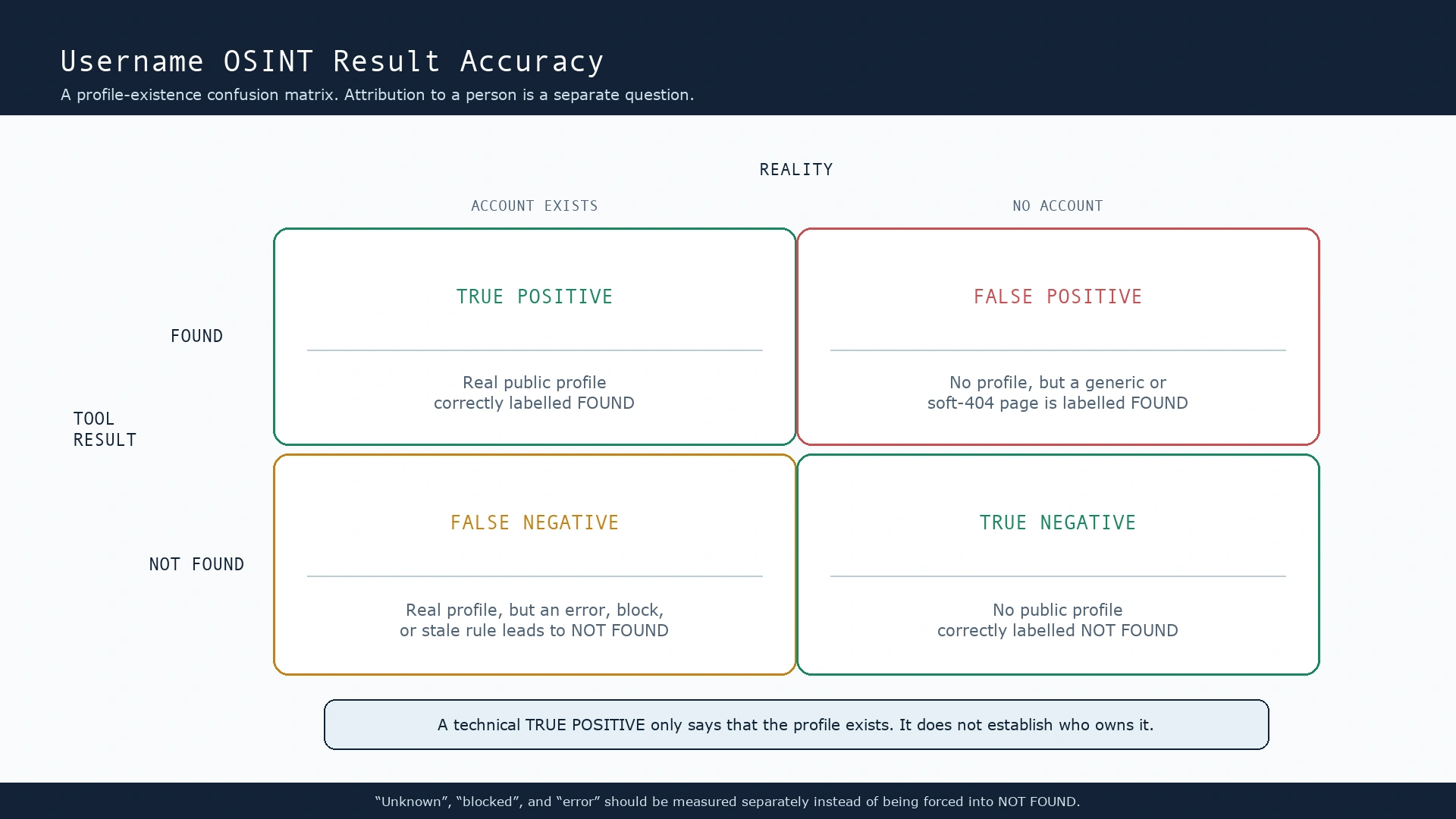
The Four Outcomes Every Username Lookup Tool Can Produce
| Reality | Tool Says Found | Tool Says Not Found |
|---|---|---|
| Account exists | True Positive: a real public profile is correctly detected | False Negative: a real profile is missed or misclassified |
| Account does not exist | False Positive: a missing profile is incorrectly reported as Found | True Negative: a missing profile is correctly reported as Not Found |
This matrix is about profile existence. It does not measure identity. If a real account named alex123 belongs to an unrelated Alex, the existence detection can still be a true positive while the attribution is wrong. That is an identity false positive, not necessarily a technical one.
Why “Unknown” Is Often Better Than a Wrong Answer
Real web requests do not always return a clean yes or no. A timeout, CAPTCHA challenge, HTTP 429 rate limit, DNS failure, unexpected redirect, login wall, server error, or changed page structure can prevent a reliable decision. A mature workflow should preserve states such as Unknown, Error, Blocked, and Rate Limited rather than silently converting them to Not Found.
That restraint is a quality feature. The current Maigret contribution guidance explicitly describes error signals as reasons to emit an UNKNOWN result instead of a false claimed or absent classification. Its documentation also recognizes that anti-bot protection and slow links can affect searches. A smaller answer set with visible uncertainty can be more reliable than a complete-looking report that has forced every failure into a binary label.
Accuracy, Precision, and Recall Are Not the Same Thing
Precision asks: of the profiles marked Found, how many actually existed? Recall asks: of the profiles that really existed, how many did the tool find? Accuracy asks: how often was the classification correct overall? Each is valuable, but raw accuracy can be misleading when most username and site pairs do not exist.
Precision = TP / (TP + FP). Recall = TP / (TP + FN). Accuracy = (TP + TN) / Total. False-positive rate = FP / (FP + TN). An additional useful measure is Unknown rate = Unknown / Total Queries. It tells you how often a system was honestly unable to classify a result.
Illustrative example — not measured tool performance
Imagine 1,000 authorized username and site checks with known ground truth: 100 real profiles and 900 missing profiles. A hypothetical tool returns 90 true positives, 10 false negatives, 40 false positives, and 860 true negatives. Its accuracy is 95%, precision is about 69.2%, recall is 90%, and false-positive rate is about 4.4%.
That 95% headline sounds strong, but 40 wrong Found labels can still create substantial review work and attribution risk. An absurd tool that always says Not Found would score 90% accuracy in this deliberately imbalanced example while finding none of the 100 real profiles. This is why a single percentage is a poor substitute for precision, recall, error states, and a documented test design.
Why Username OSINT Tools Produce False Positives
Soft 404 pages and generic profile shells
An HTTP 200 response only means the server returned a successful response. It does not mean a public account exists. Some services return a 200 page containing “user not found,” a generic search page, or a JavaScript application shell for any path. If a rule checks only the status code or a broad text fragment, it can label a non-existent account as Found. Sherlock documentation describes why error-message detection is more fragile than a clean status-based signal, while Maigret guidance warns that status-code checks are unsafe for soft 404 pages.
Redirects, interstitials, and localization
A missing username may redirect to a homepage, sign-in page, search screen, or generic error route. HTTP redirection is a normal web mechanism, and the final page can be 200 even when the original profile was absent. Anti-automation pages can create the same ambiguity: a verification interstitial may be delivered successfully while revealing nothing about the account. Language, region, and response variations can also invalidate a rule that assumes one English error message.
Username collisions and reassignment
There are two different errors here. Technically, an existing account is a correct existence finding. Investigatively, the same handle may belong to someone else. Common names and short handles make this especially likely. Platforms can also permit renamed, deleted, or reassigned usernames, so a historical owner and a current owner may not be the same person.
Why Username OSINT Tools Miss Real Accounts
- Platform changes: profile paths, HTML, error text, redirects, and public APIs change while a local rule remains old.
- Rate limits and access controls: HTTP 429 indicates too many requests; challenges and login walls can make a request indeterminate.
- Private or JavaScript-heavy experiences: a public identifier may exist, but a simple request may not receive enough dependable evidence to classify it.
- Username changes: the person may have changed a handle, leaving an old query with no current profile.
- Coverage limits: an account on an unsupported site is not a detection failure; it is outside the tool known platform set.
- Temporary errors: DNS failures, timeouts, and 5xx responses should be recorded as errors, not quietly treated as absence.
Modern JavaScript sites add another source of uncertainty. They may return a small application shell and load profile state later in the browser. It is not safe to assume every username tool renders client-side content, nor to infer a profile exists merely because the shell loaded.
How Username Tools Decide Whether an Account Exists
Most username lookup systems use platform-specific rules built around a profile URL or probe endpoint. Depending on the site, a rule may evaluate an HTTP status, a narrow response marker, the final response URL after redirects, a JSON response, a page title, or another documented signal. No single rule works perfectly across all platforms.
The current WhatsMyName project makes this architecture explicit: each entry in wmn-data.json carries a URL and expected evidence for an existing or missing username, while clients perform the actual check. The current SpiderFoot sfp_accounts module reads that dataset and includes safeguards such as skipping generic terms, optionally requiring the username on the page, and applying a minimum username length. Those are useful filters, not identity proof.
Maigret documents message, status-code, and response-URL approaches, plus optional probe URLs where they are more dependable. Its guidance notes that a public API can be more stable than parsing a web page, while also emphasizing that rate limits, challenges, and maintenance pages belong in errors. This is the practical reason two tools can disagree about the same username: their data versions, site lists, request paths, detection rules, timings, and network conditions may differ.
Why HTTP 200 Does Not Mean “Account Found”
HTTP status codes describe the outcome of an HTTP exchange, not the ownership or semantic truth of a username. A server can successfully return an error page with 200 OK. Conversely, redirects can lead a client from one URL to another before it sees a 200 page. MDN documentation on status codes, redirects, and 429 responses is useful context: protocol-level success is not application-level account verification.
For a reliable rule, the signal must be specific to that service. A narrowly tested profile marker, a dependable public API response, or a correctly handled redirect can be useful. A generic status response or page fragment is not. When the signal becomes ambiguous, Unknown is the correct result.
Username Uniqueness Changes Attribution Accuracy
Handles such as johnsmith or alex123 have low attribution value because many unrelated users may choose them. A rarer fictional handle such as PixelOrbitX47 can be a stronger correlation clue when it appears alongside compatible public context. It still is not proof. People can intentionally imitate a handle, share a naming pattern, or take over a recycled name.
| Observed result | Technical detection | Identity attribution |
|---|---|---|
| Account exists and belongs to the intended person | Correct | Potentially correct after corroboration |
| Account exists but belongs to another person with the same handle | Correct | Wrong |
| Account is missing but the tool says Found | Wrong | Wrong or unsupported |
| Account exists but the tool says Not Found | Wrong | Unknown |
More Results and More Supported Sites Do Not Mean Better Results
If Tool A reports 120 profiles and Tool B reports 70, Tool A may have higher recall, more false positives, a broader site list, or simply different failure handling. Without the same sites, known positives, known negatives, test time, network, and manual ground truth, no conclusion follows.
Site totals are especially misleading because projects count different things. A source list may include disabled entries, protected services, regional variants, test data, or rules only suitable for a particular client. More definitions increase possible coverage but also increase the maintenance burden. Treat coverage, maintenance, detection quality, and attribution value as separate variables.
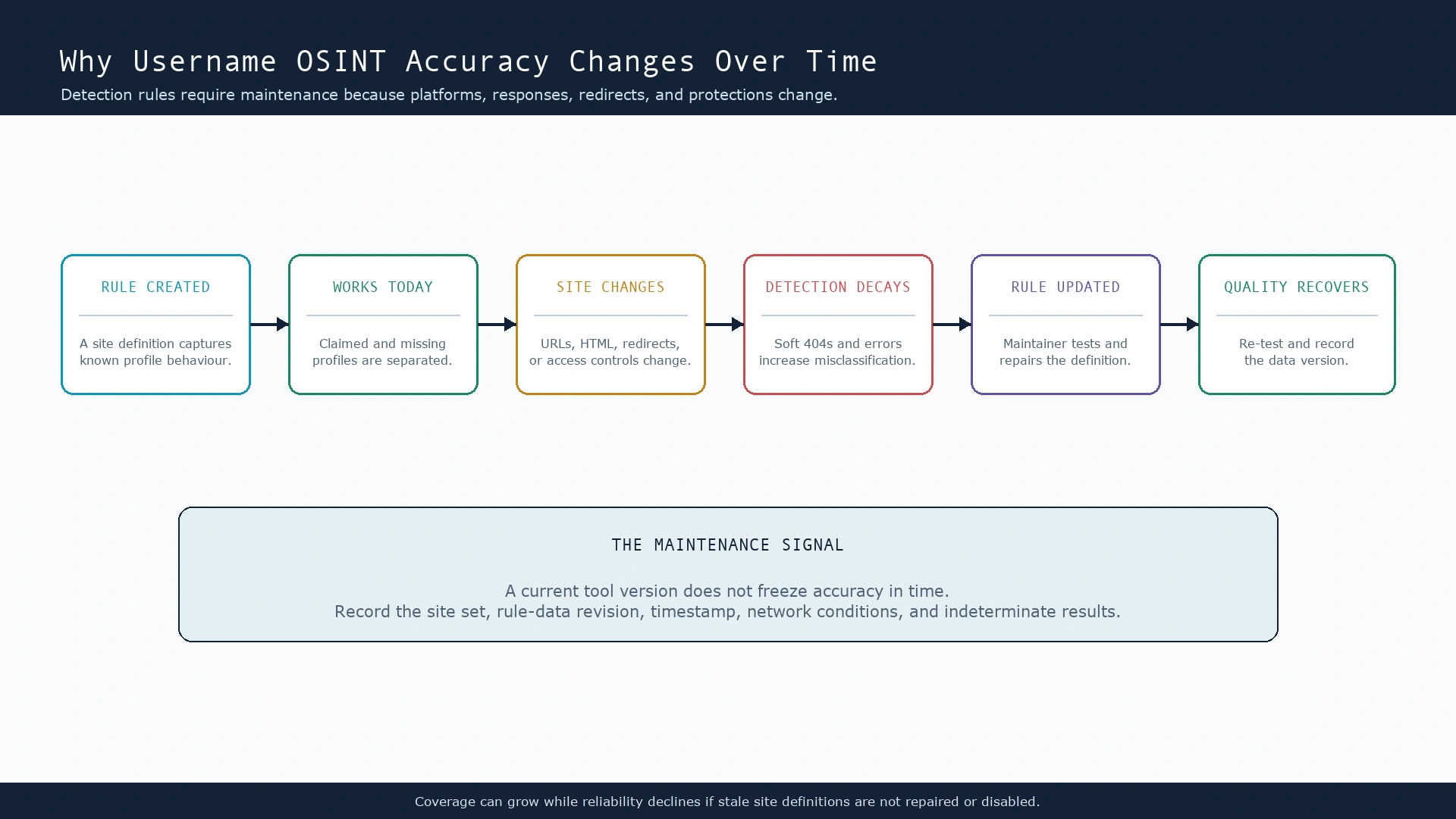
Username Search Accuracy Decays When Site Rules Stop Being Maintained
A useful mental model is detection-rule decay. A rule is created against observed platform behaviour. It works until the service redesigns a profile route, changes an error message, adds a login wall, alters a redirect, or introduces an anti-automation page. At that point, false positives, false negatives, or unknowns can increase until a maintainer tests, repairs, or disables the rule.
Current project documentation shows this is not theoretical. Maigret maintenance guidance discusses stale layouts, engines, Cloudflare, redirects, login walls, disabled sites, and false-positive diagnosis. WhatsMyName validates its data schema and allows broken sites to be marked invalid. SpiderFoot sources the WhatsMyName data for its account module. Good maintenance is therefore a meaningful signal, but it is not a universal accuracy score.
Which Username OSINT Tool Is the Most Accurate?
Without a current controlled benchmark using the same usernames, sites, rules, network conditions, timestamps, and ground-truth data, it is not responsible to declare Sherlock, Maigret, WhatsMyName, or SpiderFoot universally most accurate. They optimize different workflows and may use different definitions or data paths. Current official documentation describes their mechanisms and maintenance models, not a shared head-to-head accuracy study.
This article therefore does not manufacture a ranking. The practical choice is to inspect the source URL, retain the raw result and error state, understand the site rule that produced it, and use a tool whose output fits the authorized research task. For an accuracy-model comparison of the tools, see SpiderFoot vs Sherlock vs Maigret vs WhatsMyName.
How to Benchmark a Username OSINT Tool Properly
- Create ground truth: use accounts you control, authorized test accounts, and deliberately generated negative username and site pairs. Never use another tool output as ground truth.
- Use the same platform set: compare the same sites, not each tool default coverage.
- Run close in time: platform behaviour changes, so record a test window and every tool and rule-data revision.
- Control the network: record region, connection type, DNS behaviour, and any normal access differences that can affect a response.
- Keep indeterminate states: measure TP, FP, TN, FN, Unknown, Error, Blocked, and Rate Limited separately.
- Repeat when appropriate: a one-off timeout is not a stable performance characteristic.
- Manually verify: visit the returned public profile and inspect the exact evidence used for the ground-truth label.
A good benchmark needs difficult cases
Include common and unusual usernames, short and long handles, names with digits, clear 404 services, soft-404 services, redirect-heavy services, protected sites, and varied platform categories. A benchmark containing only easy 404s can produce impressive numbers while failing to represent the sites an analyst actually needs. Any real benchmark must publish methodology, sample size, versions, dates, site set, and ground truth.
Speed, Network Location, and Time Can Change the Result
High concurrency can make a scan faster, but it may also increase timeouts or trigger rate limits and protective responses. This does not mean slower is always more accurate; it means speed is part of the measurement environment. Similarly, services can vary by region, locale, IP reputation, or temporary availability. Two analysts can run the same version on the same handle and receive different results.
Username OSINT is time-sensitive. A benchmark from 2024 does not describe 2026 platform behaviour, rule-data maintenance, or account status. Current username lookup is also not a historical identity database: renamed, deleted, reassigned, and archived accounts may leave evidence that a current profile check cannot answer.
If Several Tools Agree, Is the Result More Reliable?
Sometimes agreement is useful for coverage, but it is not automatically independent confirmation. Several tools may query the same profile URL, use overlapping detection data, or react to the same generic page. Three Found results can still be one website signal repeated three times.
Stronger verification comes from different evidence types: an exact username, a linked public website, compatible biography details, a direct cross-link, a publicly visible project history, or contradictory evidence. These signals still need careful contextual review. They should be recorded as qualitative confidence, not converted into invented probabilities such as “87% likely.”
Fictional Case Study: PixelOrbit47
Assume a person is checking their own public digital footprint with the fictional handle PixelOrbit47. Three tools return Found on Platforms A, B, and C; a fourth returns Not Found on Platform D. Raw output alone looks like three hits and one miss.
| Platform | Initial tool result | Manual verification | Interpretation |
|---|---|---|---|
| A | Found | Exact handle, same public avatar, and the owner linked website | Likely correct identity match |
| B | Found | Real account, but unrelated biography and public links | Technical true positive; identity mismatch |
| C | Found | Generic error page for arbitrary URLs | Technical false positive |
| D | Not Found | Real account visible in a normal browser; automated request had been blocked | Technical false negative or indeterminate request |
The verified interpretation is not “three accounts found.” It is one likely self-owned account, one unrelated account, one technical false positive, and one missed or blocked account. This is why Found and Not Found are leads to review, not the final conclusion.
How to Verify a Username Result Before Trusting It
- Treat Found as a lead and open the original public profile URL.
- Confirm that the profile, not a generic landing or error page, genuinely exists.
- Check the exact handle, then inspect any publicly visible age, bio, linked websites, and direct cross-links.
- Consider handle uniqueness, but do not confuse uniqueness with proof.
- Look for contradictory details as actively as supporting ones.
- Record timestamp, source URL, tool version, data revision, raw status, and error state.
- Use low, medium, high, or insufficient-evidence labels for attribution, and re-check high-impact findings.
For a broader discussion of evidence discipline, read Why OSINT Results Can Be Wrong: False Positives and What Can Someone Find From Your Username?.
Frequently Asked Questions About Username OSINT Accuracy
Are username lookup tools accurate?
They can accurately surface candidate public profiles, but quality varies by site, rule freshness, network conditions, and the distinction between existence and identity.
Can Sherlock give false positives?
Yes. Any rule-driven checker can misclassify generic pages, soft 404s, redirects, or changed site behaviour. Verify the profile URL manually.
Can Maigret produce false positives?
Yes. Maigret official guidance explicitly discusses false positives and the need to maintain or disable problematic site definitions.
What does Found mean in a username lookup tool?
It means the tool detected evidence consistent with a public profile at a URL. It does not mean it found the person behind the account.
Why does one tool find an account while another does not?
They may use different site sets, data revisions, request paths, detection logic, timing, or error handling.
Is the same username proof of the same person?
No. A shared handle is a correlation lead, especially for common names, not proof of identity.
Which username OSINT tool is the most accurate?
No defensible universal winner exists without a current controlled benchmark with shared ground truth and conditions.
Why do username OSINT tools miss real accounts?
Stale rules, rate limits, access controls, renamed accounts, unsupported sites, and temporary errors can all create misses.
What is a soft 404?
A soft 404 is a page that behaves like an absent-account page but returns a success response such as HTTP 200, which can confuse a simplistic rule.
Does HTTP 200 mean a profile exists?
No. It means the server returned a successful HTTP response, which may still be a generic, missing-user, or challenge page.
Are tools with more supported websites more accurate?
No. More definitions may increase coverage and maintenance burden; they do not directly measure precision, recall, or identity attribution.
How should I verify username OSINT results?
Open the source, confirm the profile state, compare relevant public context, look for contradiction, record uncertainty, and keep existence detection separate from attribution.
Final Takeaway
Username OSINT accuracy is a measurement problem, not a marketing claim. Use precision, recall, false-positive rate, false-negative rate, and unknown rate for technical detection. Use separate, cautious evidence review for identity attribution. Record the conditions of a run, verify high-impact results manually, and never let a polished Found label substitute for ground truth.
Sources and Further Reading
- Sherlock official repository
- Sherlock: Adding Sites and detection algorithms
- Maigret official repository
- Maigret contribution guidance for false-positive handling and site checks
- Maigret usage documentation and false-positive note
- WhatsMyName official repository and data model
- WhatsMyName data schema
- WhatsMyName contribution and rule-testing guidance
- SpiderFoot account module source and filtering options
- MDN: HTTP response status codes
- MDN: HTTP redirections
- MDN: HTTP 429 Too Many Requests
- Bellingcat editorial standards and practices
- Bellingcat and GLAN methodology for verification and reliability
- Bellingcat: Video Analysis Shows Two Waves of Bombings in Iran Elementary School Strike