A username result is a technical observation about a public route—not a conclusion about a person. This article explains what the current SpiderFoot.tools implementation actually does when it reports a username candidate, where the evidence comes from, and why responsible verification still happens after the scan.
Quick Answer: How Does SpiderFoot.tools Find Username Matches?
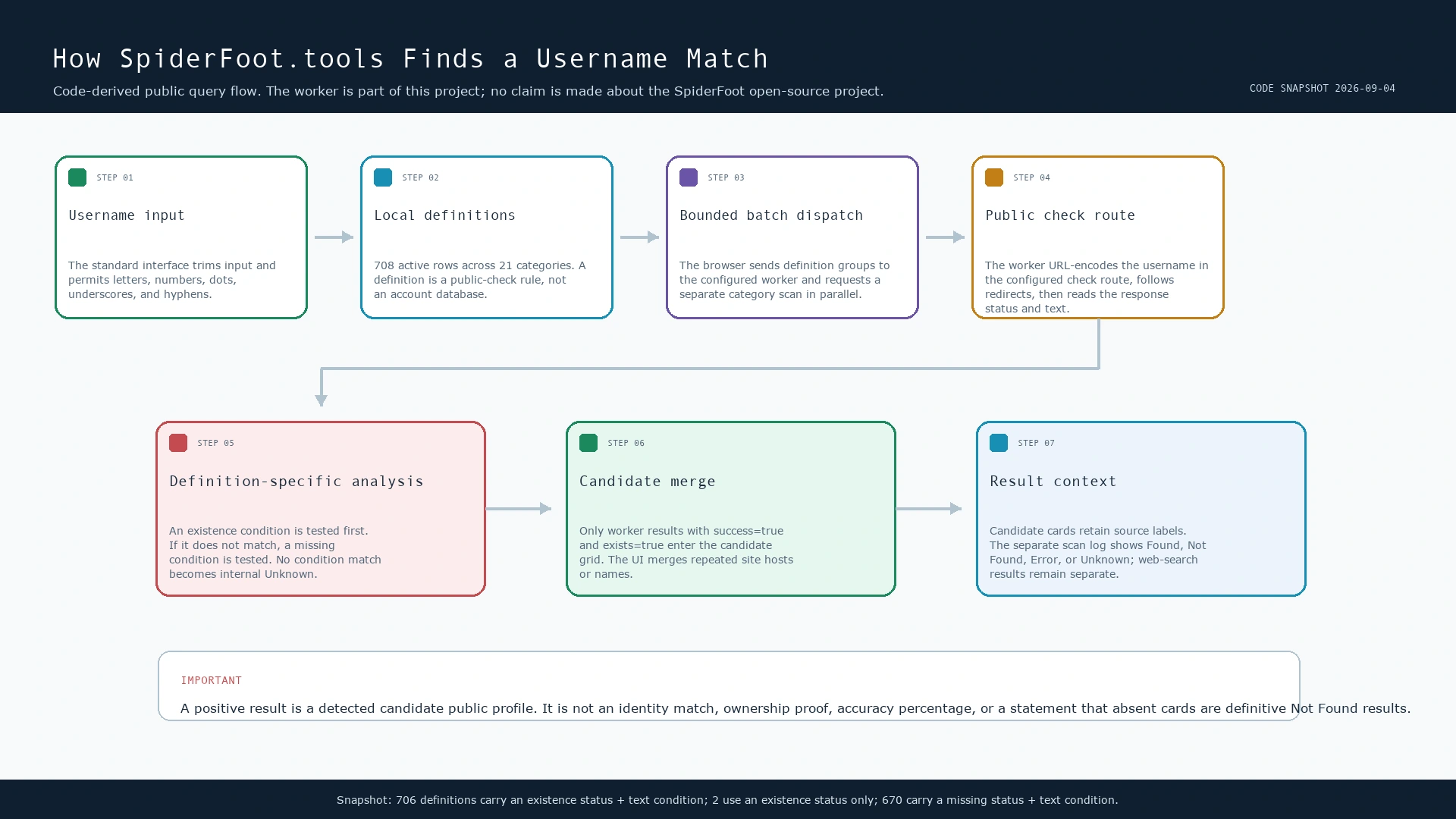
The standard SpiderFoot.tools username search interface does not look up a person in a universal username database. It loads a local collection of platform definitions, sends those definitions in bounded batches to a configured worker, and asks that worker to check public routes. Each definition tells the worker how a particular platform response may indicate that a public username route exists or is missing. The worker evaluates the returned HTTP status and response text against that platform-specific definition.
A worker result enters the candidate-profile grid only when it is both successful and marked exists=true. A separate scan API runs alongside the worker and contributes a category-based log; only its normalized Found status is added to the same candidate grid. A Google organic-results section, when enabled for a request, is displayed separately and is not counted as a candidate profile match.
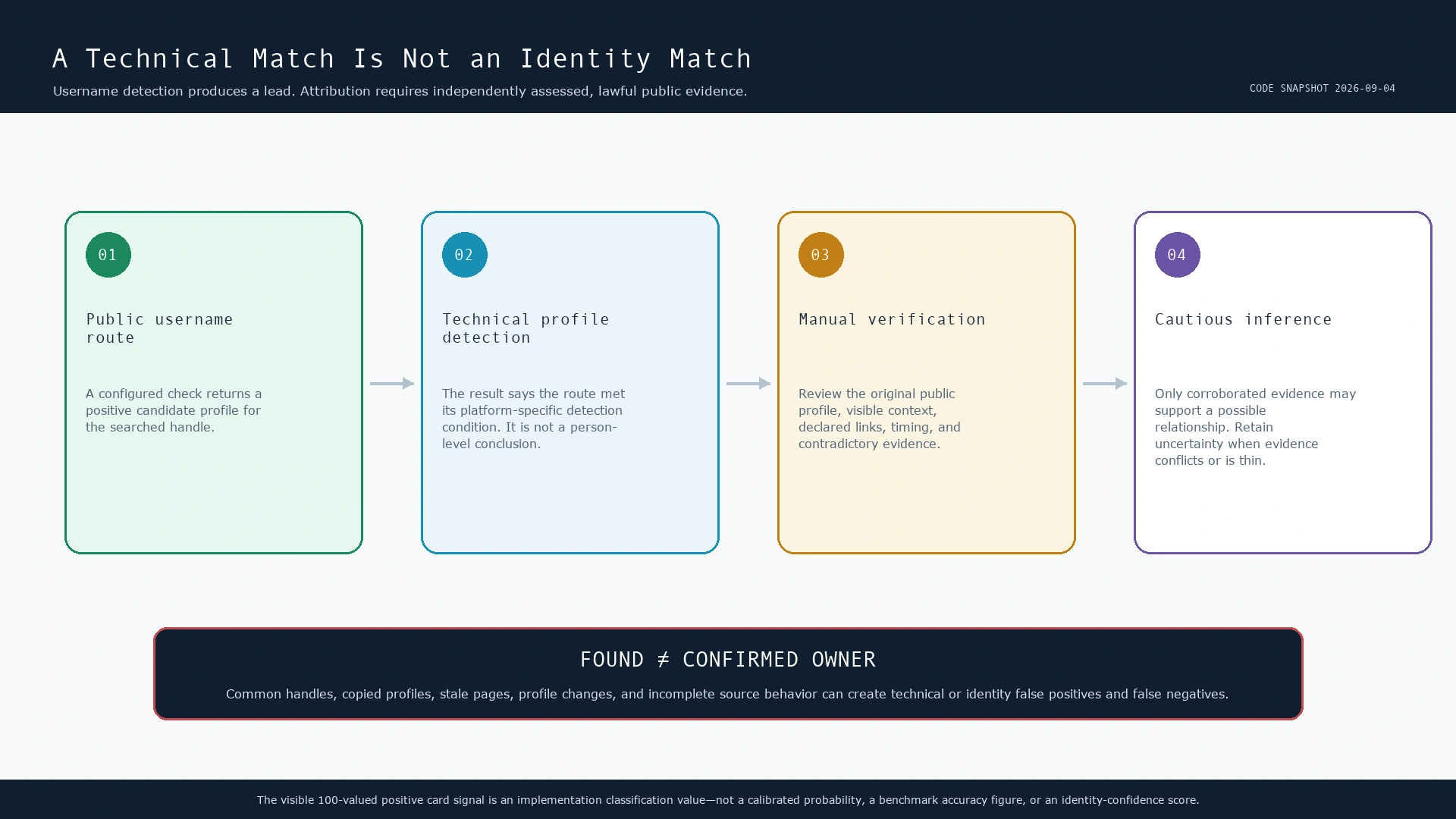
Found means a candidate public profile was detected under a current source rule. It does not mean that a person's identity, ownership, intent, or relationship to other accounts was confirmed.
This article describes SpiderFoot.tools, an independent third-party web service. It does not claim to describe, represent, or use the modules of the separate SpiderFoot open-source project unless a relationship is specifically documented elsewhere.
SpiderFoot.tools Does Not Have a Database of Every Username
The local dataset is a collection of public-check definitions, not a directory of every account or every person. At the snapshot date it contained 708 active definitions in 21 categories. Every active definition contains a route used for a check. Some also contain a more human-friendly public profile URL for the result card. The definitions tell the system where and how to look; they are not records that assert a particular username exists.
There are two useful consequences. First, a platform can be “supported” even though the service has no partnership with it and no access to private accounts. Second, the definition list is not a completeness claim. A platform may have a public profile convention that has not been added, may change its behavior, or may be temporarily unreachable. Four definitions are language-tagged for Chinese browsers, while 704 are unrestricted; the browser filters language-tagged definitions using its language list, so the number attempted in an individual session can be smaller than the configured total.
What Happens to a Username Before the Search?
In the standard interface, SpiderFoot.tools trims surrounding whitespace and accepts usernames made of letters, numbers, dots, underscores, and hyphens. It does not lowercase the value before the scan. When the worker substitutes the value into a configured route, it URL-encodes that value. This prevents route syntax from being confused with the username itself while preserving the user-entered handle for a platform to evaluate.
This is input handling, not identity normalization. A platform may treat case, punctuation, aliases, renamed handles, or Unicode differently from another platform. If an expected account uses a different spelling, the fact that one exact input produced no positive candidate does not settle the question. Use legitimate variations only when they are relevant to an authorized self-audit or investigation, and keep the variants separate in your notes.
How SpiderFoot.tools Knows Which Platforms to Check
Each local definition carries a display name, a category, a public check route, and response conditions. A definition can also provide a preferred profile URL for the user-facing card when the route that is best for checking is not the route that is best for a person to open. At this snapshot, 174 of the 708 definitions include that preferred display URL. The rest can present the check route when it is also the appropriate public destination.
The underlying format follows a public-profile-definition approach documented by projects such as WhatsMyName’s schema: a check route can include an account placeholder and a site can define the response conditions that distinguish an existing from a missing account. SpiderFoot.tools evaluates its own local copy and its own worker code; a similar format does not mean that two services share current coverage, maintenance practices, or results.
| Definition attribute | Current snapshot | Why it matters |
|---|---|---|
| Active public-check definitions | 708 | Configured routes to attempt; not account records or independent data providers. |
| Categories | 21 | Organizational labels for the definition set, not quality or accuracy grades. |
| Existence status + text conditions | 706 | Most positive rules require both a configured response status and a response-text marker. |
| Existence status-only conditions | 2 | A small number of positive rules use their configured status condition without a text marker. |
| Missing status + text conditions | 670 | Many definitions also recognize a platform-specific missing-account response. |
| Missing status-only conditions | 38 | Some missing-account rules rely on their configured status condition alone. |
How Profile Routes Are Built
The browser does not independently open 708 platform pages. It packages a username with a group of definitions and sends that batch to the worker. The worker substitutes the encoded username into each definition’s public check-route template. Where a definition provides a preferred public profile route, that route is used for the result card; otherwise, the checked route is used.
For a fictional handle such as PixelOrbit47, a definition may conceptually describe a route like https://example.invalid/profile/{account}. The worker substitutes the encoded handle before requesting the configured public route. This article intentionally uses a reserved example rather than a real individual or an undisclosed platform endpoint.
A predictable route is not proof that an account exists. Many services return generic pages, sign-in screens, home pages, validation pages, or app shells for a route that looks valid. That is why the implementation also evaluates the response rather than equating a constructed URL with a match.
Why HTTP Status Codes Are Useful—But Not Enough
HTTP status codes describe the outcome of an HTTP request, not the ownership or even the semantic meaning of a username. A 200 response means a server successfully completed a request; it does not universally mean that a public profile exists. A 404 can be a strong missing-account signal for one platform, while another platform may use a successful response and show an error in the page body. Other responses can reflect authorization, throttling, server trouble, or an intermediary page. See the MDN HTTP status reference and RFC 9110 for the protocol meaning of these codes.
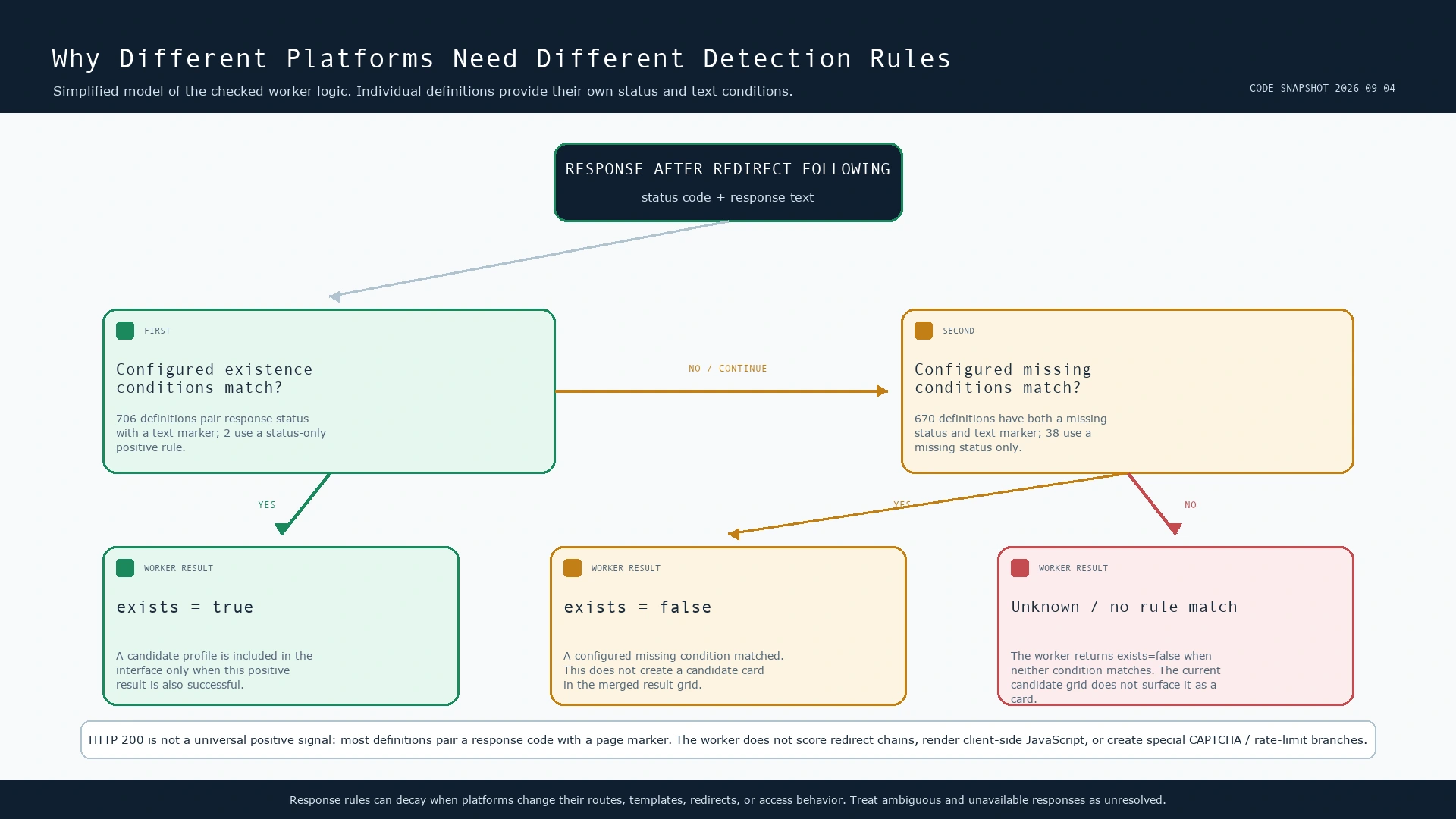
The worker therefore evaluates an existence condition first. In the predominant pattern, a configured status and configured response-text marker must both match. If that positive condition does not match, the worker evaluates the definition’s missing-account condition. If neither condition matches, the worker returns an internal Unknown outcome with exists=false. This is a deliberately narrower claim than “any 2xx response is Found.”
Soft 404s: a successful page that is still an error
A soft 404 is a useful general term for an error-like page delivered with a successful HTTP response. Google describes this pattern in its 404 and soft-404 guidance. In username work, a platform could return 200 for a non-existent handle but include a “user not found” message or a generic empty page. A response-text rule helps distinguish this from a real profile only when the rule remains current and the text is actually available to the worker.
It is not a universal cure. Two current positive definitions are status-only; platforms can alter templates; and JavaScript-heavy pages can return little useful initial HTML. Every result remains a dated observation of a platform’s behavior under one rule, not an enduring assertion about that platform or username.
Redirects, Page Content, and JavaScript-Heavy Platforms
The worker sets its public request to follow redirects. It then analyzes the status and response text it receives after normal redirect following. The reviewed code does not separately score the redirect chain, compare the final URL against the requested URL, or turn a redirect itself into a global Found/Not Found rule. This matters because redirects can lead to a sign-in page, a generic page, a renamed route, or an otherwise ambiguous destination. HTTP redirects are transport behavior; see MDN’s redirection guide and Cloudflare’s Worker request documentation for the meaning of follow, error, and manual redirect modes.
Page content is therefore important for the definitions that include text markers. The worker reads the response text and checks it against the configured condition. It does not render a page in a browser or execute a platform’s client-side application code. A route whose profile information appears only after client-side JavaScript runs may consequently look incomplete or ambiguous to this request-based method. That limitation is not evidence that an account does or does not exist.
Likewise, the reviewed worker has no dedicated global CAPTCHA, anti-bot, or rate-limit result branch. It does not attempt to bypass access controls. If an access page, challenge, or throttled response fails to meet either platform condition, it ends up as an internal non-positive outcome; if the network request fails, it becomes a failed site check. The current candidate grid does not turn either circumstance into a positive profile card.
Concurrency, Failures, and What the Interface Shows
To avoid making a user wait for each platform one by one, the browser divides the definitions into configured groups and runs a bounded number of worker requests at once. Inside each worker batch, site checks are settled independently. A failure on one site does not need to stop the rest of the batch. The reviewed code catches worker failures and lets the overall scan complete with partial-error warnings when other work succeeds.
The worker source passes a timeout option to its request code, but it has no explicit abort-controller implementation or per-site retry loop in the reviewed path. It should not be read as a service-level response-time guarantee. Network errors, access blocks, and changed behavior are normal sources of incompleteness in public web checks.
The separate scan API has a different, visible result vocabulary. Its log adapter recognizes Found, Not Found, and Error; an unexpected value is shown as Unknown. Only the normalized Found status is considered positive for a candidate card. The worker has an internal Unknown outcome too, but the current front-end only renders worker items with both success=true and exists=true. As a result, the candidate grid is a positive-lead display, not a complete per-platform audit table.
What “Found” Means on SpiderFoot.tools
There are two current ways a username candidate can reach the grid. A worker candidate must complete successfully and satisfy its definition’s existence condition. A separate scan-API item must normalize to Found. The front-end then merges duplicates by normalized hostname when it can, or by normalized site name otherwise, and labels the result as Worker, API, or Merged.
The card’s visible 100% value is not a calibrated probability of account existence or an identity-confidence score. In the reviewed code, a positive worker rule returns a 100-valued classification signal; a positive scan-API item is also assigned 100 when it is converted into a candidate card. No cross-platform scoring model, benchmark-derived accuracy percentage, or person-attribution engine was found in this matching path.
- Found means a current source condition produced a candidate public-profile observation.
- It does not mean that the profile belongs to the person you had in mind, is active today, is official, or is connected to another same-name profile.
- It does not mean SpiderFoot.tools accessed a private account, private messages, credentials, or a platform’s internal user database.
What “Not Found,” “Unknown,” and an Absent Card Mean
For the separate scan API, Not Found is an explicit status label in the scan log. It means that source did not return its positive condition for that item at that time. Error means the source reported an error. Unknown is the adapter’s fallback for an unexpected status. None of these should be stretched into a broader claim about all platforms or all possible spellings of a username.
For worker definitions, a configured missing-account condition results in exists=false. When neither configured condition matches, the worker’s reason is Unknown and exists is also false. The candidate-grid extraction intentionally excludes both outcomes. Therefore, an absent worker card means only that the current front-end did not receive a successful positive worker result for that definition. It is not a definitive, visible per-platform Not Found verdict.
This distinction matters when a service returns a login page, a bot-protection challenge, a generic response, a changed template, or incomplete HTML. A tool that silently converts every ambiguous response into a negative can create false certainty. The current interface is more conservative in the candidate grid, but users should still treat a non-result as unresolved unless the original public platform can be checked safely and lawfully.
Technical False Positives vs. Identity False Positives
A technical false positive occurs when a rule concludes that a public profile exists even though the response was really a generic, changed, or misleading page. A soft 404, an unexpected redirect destination, stale response text, and a changed platform template can create this kind of mistake. A false negative occurs when a real profile is not detected because its route changed, the response requires client-side rendering, the source returned an access block, or the current definition no longer fits the platform.
An identity false positive is different: the profile is real and the technical observation may be correct, but it belongs to another person using the same handle. Common handles are especially vulnerable to collisions. Even an unusual handle can be copied, inherited, impersonated, or reused. Ten positive candidates are ten public leads—not ten confirmed accounts owned by one person.
Separate What SpiderFoot.tools Observes From What You Infer
| Layer | Example using the fictional handle PixelOrbit47 | What is justified |
|---|---|---|
| Observation | A configured public route met the definition’s positive condition for PixelOrbit47. | A candidate public profile was detected at the displayed route. |
| Technical interpretation | The rule used status and/or response-text conditions that matched at query time. | The rule produced a positive classification, subject to platform changes and source limitations. |
| Identity inference | “This profile belongs to a particular person.” | Not justified without independent, lawful corroboration. |
| Attribution decision | “Several profiles belong to the same owner.” | Requires documented, context-specific evidence and retained uncertainty. |
Useful corroboration can include public cross-links, a self-declared personal site, consistent public biography details, visible project links, timing, and contradictory evidence. It should never include an attempt to defeat a login, CAPTCHA, rate limit, or other access control. For a general explanation of handle exposure and context, read What Can Someone Find From Your Username?; for a deeper review of uncertainty, see Why OSINT Results Can Be Wrong.
Why Rules Need Maintenance—and Why Coverage Is Not Accuracy
Platform rules age. A service can change a profile URL, replace a server-rendered page with a JavaScript application, alter a missing-account message, add a consent wall, return a different redirect, or block automated requests. Any of those changes can make a once-valid response condition unreliable. The local definition format supports marking broken sites as disabled, but all 708 definitions were active in the repository snapshot. That is a configuration count, not a health score.
The repository also contains a separate benchmark artifact for a selected set of public profile routes. It uses its own probe method and must not be mistaken for an end-to-end test of every production worker definition or an accuracy claim for SpiderFoot.tools. No percentage is published here because a meaningful accuracy number would require a reproducible ground-truth dataset, a defined sample, review rules, and a statement of limitations. More supported routes can broaden discovery; they do not automatically make every result more reliable.
Public username tools such as Sherlock and Maigret also document the maintenance burden of site-specific response behavior. That is a useful general lesson, not a claim that SpiderFoot.tools is those projects or uses their runtime code.
Are Username Results Live? What Happens to a Query?
The common worker scan makes public-route requests at search time; the reviewed front-end and PHP path do not define a separate application cache for those worker candidate results. A favicon cache used after a positive result does not decide whether the account exists. The optional Google organic-result section has its own application caching behavior and remains outside the candidate profile grid. Freshness still depends on the platform response, intermediate caches, and whether the route is currently reachable.
A username query is also not anonymous merely because it is submitted in a browser. The application creates a search-history task and saves the submitted username and positive candidate records with timestamps. The worker and separate scan API receive the query as part of their applicable request paths. Review the current Privacy Policy and Methodology before submitting identifiers, and use the service only for authorized, defensive, research, or self-audit purposes.
How to Verify a SpiderFoot.tools Username Match
- Open the original public profile route shown by the result—not a screenshot or a copied preview.
- Confirm that it is a real profile or account page rather than a generic, sign-in, error, or redirect destination.
- Check the displayed username exactly, including platform-specific punctuation or casing.
- Record the source label, route, and time of observation if the finding may matter later.
- Look for public, independent context such as declared links or a consistent bio; do not assume similarity proves ownership.
- Look actively for contradictory evidence: a different location, topic, organization, time period, or profile owner.
- Keep unsupported conclusions as uncertainty, especially for common usernames or high-impact decisions.
For a broader comparison of public username-checking approaches, see SpiderFoot.tools vs Sherlock vs Maigret vs WhatsMyName. The practical rule is simple: a result card is the beginning of verification, not the end of it.
Frequently Asked Questions About Username Matches
Does SpiderFoot.tools have a database of every username?
No. The reviewed local dataset contains public-check definitions. It is not a complete index of all accounts, people, or platforms.
Does HTTP 200 mean a username exists?
No. Most current positive definitions combine a configured status with a response-text marker. A successful HTTP response can still be a soft 404, a generic page, or another ambiguous response.
What does Found mean?
It means the worker or scan API produced a current positive candidate according to its source rule. It does not verify a person’s identity or ownership of the profile.
What does no candidate card mean?
It means the candidate grid received no successful positive item for that route. It is not a conclusive statement that an account does not exist.
Why can a real account be missed?
Routes, templates, client-side rendering, access blocks, rate limits, outages, renamed handles, and stale definitions can all make a public check ambiguous or non-positive.
Does SpiderFoot.tools access private accounts?
No such capability is described by this username-matching implementation. The workflow is based on configured public routes and public responses; it is not a way to bypass platform access controls.
Can multiple matches confirm one person?
No. Repeated handles are a pattern worth assessing, not proof. Confirm only what independently available public evidence supports.
Sources and Further Reading
- MDN — HTTP response status codes
- IETF — RFC 9110: HTTP Semantics
- MDN — Redirections in HTTP
- Cloudflare Developers — Workers Fetch API
- Cloudflare Developers — Request and redirect handling in Workers
- Google Search Console Help — 404 and soft-404 errors
- WhatsMyName — public site-definition schema
- Sherlock — site definition and validation guidance
- Maigret — contribution guidance for public username checks
- Bellingcat — editorial standards, verification, and proportionality