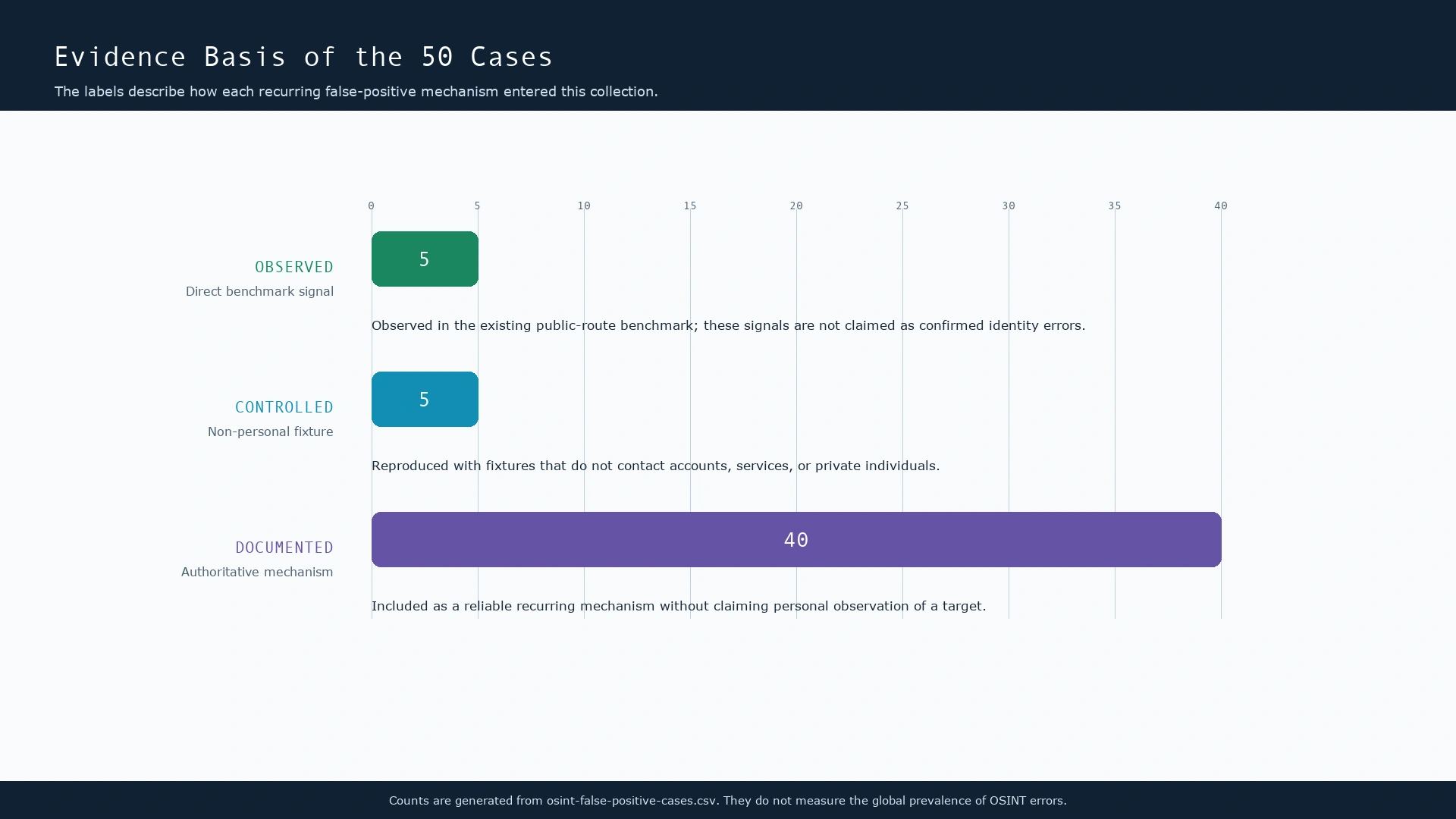
Editorial scope: This is a 50-case reference guide, not a claim that every item was personally observed on a real person or platform. The title's “We Found” refers to the documented collection we assembled and audited: 5 direct benchmark signals, 5 controlled reproductions, and 40 authoritatively documented recurring mechanisms.
Core rule: A match is not the same as a verified identity. Correct data can still lead to an incorrect conclusion.
Quick Answer: Why Do OSINT False Positives Happen?
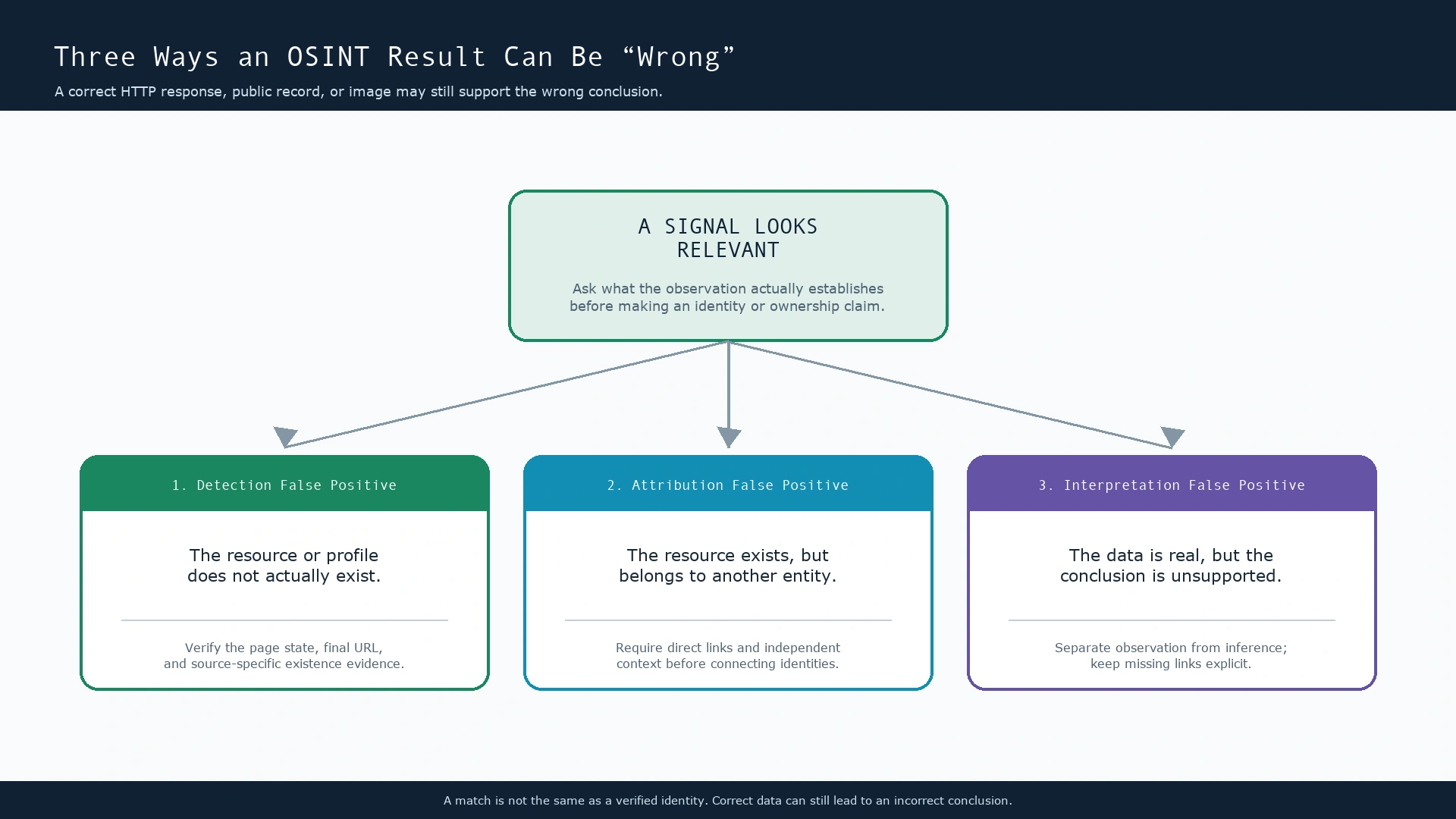
An OSINT false positive occurs when a signal looks relevant but fails at one of three stages: the resource was not really detected, the real resource belongs to a different entity, or the data is interpreted more strongly than it supports. The distinction matters. A username route may exist, an IP may be correct, and an old registration record may be authentic—yet none of those facts alone proves who controls an account, domain, or action today.
We built this field guide from a maintained 100-username × 20-platform benchmark summary, six local non-personal fixtures, and primary technical or methodology sources. The benchmark made 2,000 public, unauthenticated route checks on 4 September 2026 and deliberately kept ambiguous successes, blocks, and rate limits out of its positive result class. Its manually reviewed positive routes produced no verified technical false positives; that restraint is itself an important observation. This article therefore never says that an ambiguous benchmark signal was a confirmed account error.
Read every finding in two sentences: first state the observation; then state the inference, if any. Only the first sentence is automatically supplied by a lookup.
How We Collected and Verified These Cases
Each of the 50 rows in the accompanying research dataset has one evidence label. Observed means the specific condition appeared in the current public-route benchmark. Controlled means a local fixture reproduced the decision error using no target accounts, personal data, credentials, private services, or bypasses. Documented means a reliable technical or methodology source supports the mechanism, but we do not claim personal observation of a particular affected target. The labels describe evidence origin, not probability or global frequency.
| Evidence basis | Cases | Meaning in this guide |
|---|---|---|
| Observed | 5 | Direct benchmark signal |
| Controlled | 5 | Non-personal controlled fixture |
| Documented | 40 | Authoritative recurring mechanism |
A Simple Taxonomy of OSINT False Positives
Detection false positive: a tool calls a resource Found when it is absent or the response is non-specific. Attribution false positive: the resource exists but is incorrectly tied to a person or organization. Interpretation false positive: the data is true, but its meaning is overstated—such as treating shared hosting as common ownership. One case can touch more than one type, but this guide places it under the lesson most useful for verification.
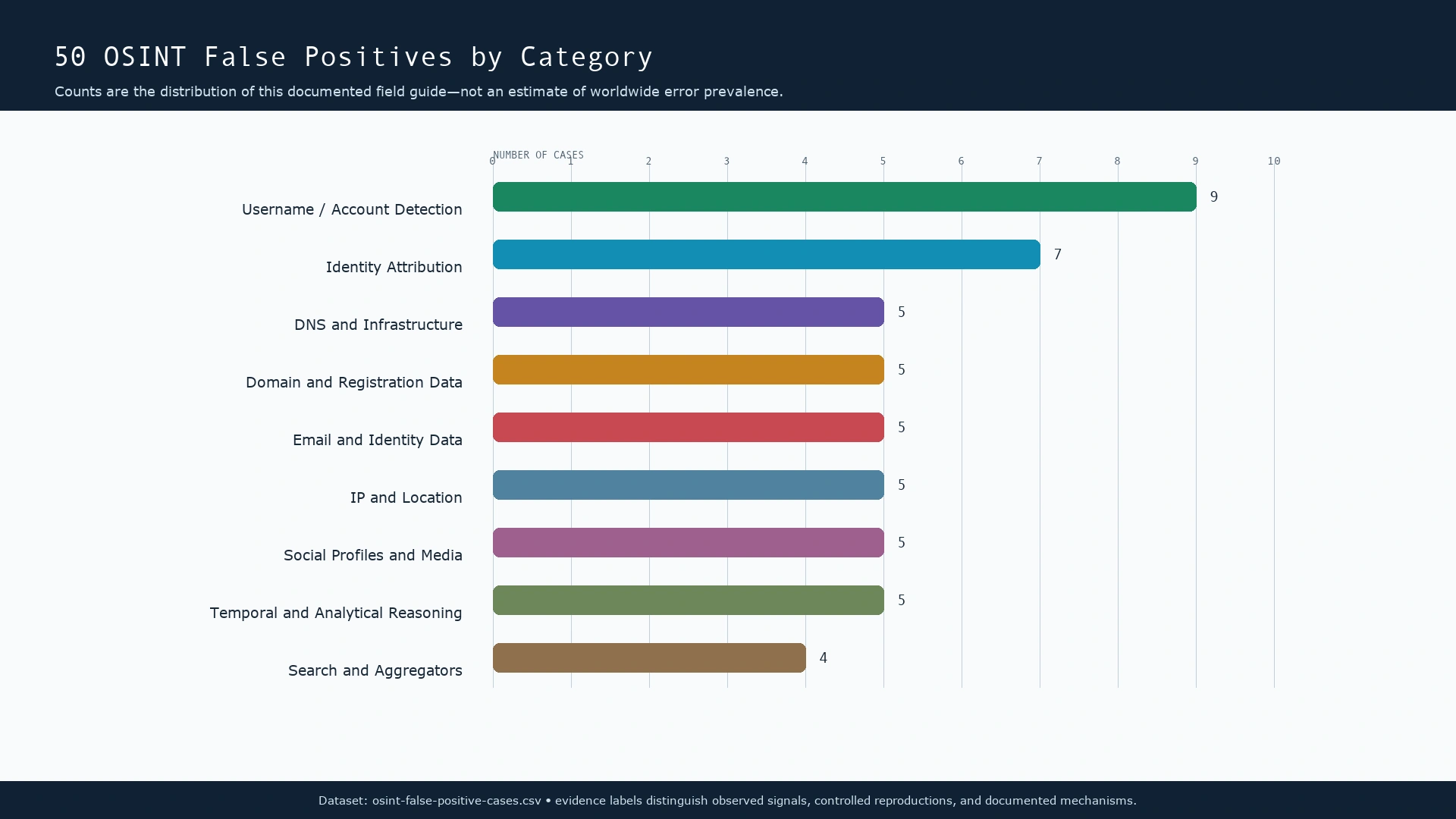
| Category in this guide | Cases |
|---|---|
| Username / Account Detection | 9 |
| Identity Attribution | 7 |
| Email and Identity Data | 5 |
| Domain and Registration Data | 5 |
| DNS and Infrastructure | 5 |
| IP and Location | 5 |
| Social Profiles and Media | 5 |
| Search and Aggregators | 4 |
| Temporal and Analytical Reasoning | 5 |
1–9. Username / Account Detection
1. A 2xx Page With No Handle Evidence
What looks like a match: A requested public profile route returns HTTP 200, so a status-only checker appears to have found an account.
Why it can be wrong: In our benchmark, 2xx pages without a title match were deliberately retained as Unknown. A successful transport response says that a server answered; it does not establish that the requested profile exists.
How to verify it: Open the final public page, inspect the visible account context, and require platform-specific existence evidence before presenting a positive candidate.
Evidence basis: Observed in our test. This denotes a direct condition in the 4 September 2026 public, unauthenticated benchmark; it does not turn the condition into a claim about a real person's identity. Impact: Moderate.
2. Soft 404 Treated as a Live Profile
What looks like a match: A guessed route returns HTTP 200 and an attractive, site-branded page, which a simple checker labels Found.
Why it can be wrong: The controlled fixture returned 200 while its page semantics said the resource was unavailable. Google documents this general soft-404 failure mode: an error page can carry a success status.
How to verify it: Compare status, final URL, title, visible page state, and a known-negative route. Record Unknown when those signals conflict.
Evidence basis: Controlled reproduction. This mechanism passed a local, non-personal fixture. It demonstrates the decision error without asserting that a named platform currently behaves this way. Impact: High.
3. Generic Landing Page at Every Guessed Route
What looks like a match: Many handle-shaped URLs show the same home, help, or app shell page and therefore seem to be valid profiles.
Why it can be wrong: A generic fallback may be served for paths that do not map to an account. A branded page is not account-specific evidence, and a 200 response cannot repair that gap.
How to verify it: Compare a known account, a known-negative synthetic route, and the candidate page. Look for an account identifier or source-specific profile content.
Evidence basis: Documented mechanism. It is included from authoritative technical or methodology material. We do not claim to have personally observed a particular target affected by it. Impact: Moderate.
4. Login Redirect Mistaken for a Profile
What looks like a match: A profile-shaped route changes destination during the request, and the final page loads successfully after a redirect.
Why it can be wrong: The benchmark recorded redirects among public-route checks. A final login or access page may be a valid web response without proving the requested handle or even exposing a profile.
How to verify it: Preserve the requested and final URLs, classify authentication destinations as indeterminate, and review the destination manually before using it as evidence.
Evidence basis: Observed in our test. This denotes a direct condition in the 4 September 2026 public, unauthenticated benchmark; it does not turn the condition into a claim about a real person's identity. Impact: High.
5. Help or Search Redirect Taken as a Username Match
What looks like a match: A generic word used as a handle leads to a support, search, or product page whose title repeats that word.
Why it can be wrong: The title can contain the query while referring to a feature rather than an account. A lexical match is not the same as a profile-type match.
How to verify it: Check the page's entity type, account metadata, and canonical destination. Treat a help or search context as a route ambiguity, not a person or account finding.
Evidence basis: Observed in our test. This denotes a direct condition in the 4 September 2026 public, unauthenticated benchmark; it does not turn the condition into a claim about a real person's identity. Impact: High.
6. Challenge Page Read as a Profile
What looks like a match: A web protection or interstitial page loads successfully and contains enough site branding to resemble a reachable profile.
Why it can be wrong: The response represents an access decision, not account existence. A client that does not distinguish page purpose can convert an access obstacle into a positive signal.
How to verify it: Do not bypass the control. Mark the result Blocked or Unknown, preserve the response class, and retry only through an authorized normal browser workflow if appropriate.
Evidence basis: Documented mechanism. It is included from authoritative technical or methodology material. We do not claim to have personally observed a particular target affected by it. Impact: High.
7. Rate Limit Collapsed Into Not Found
What looks like a match: A service returns a rate-limit response, but a tool or analyst treats the lack of profile content as proof that no account exists.
Why it can be wrong: The benchmark recorded rate-limited outcomes separately. A 429 reports a request condition, not the existence state of the resource, so converting it into a negative produces an unsupported conclusion.
How to verify it: Record the rate limit and timestamp, slow or stop within the service's rules, and leave the account state Unknown until a legitimate later check is possible.
Evidence basis: Observed in our test. This denotes a direct condition in the 4 September 2026 public, unauthenticated benchmark; it does not turn the condition into a claim about a real person's identity. Impact: Moderate.
8. Language-Specific Missing Marker
What looks like a match: A detector looks for one English phrase that historically signaled a missing account.
Why it can be wrong: Localized, redesigned, or accessibility-oriented pages can express the same state without that exact marker. An absent marker is weak evidence that a profile exists.
How to verify it: Test with known-positive and known-negative routes in the same locale, then validate the visible state and update rules only after review.
Evidence basis: Documented mechanism. It is included from authoritative technical or methodology material. We do not claim to have personally observed a particular target affected by it. Impact: Moderate.
9. JavaScript Shell Mistaken for Account Content
What looks like a match: A fetch sees a 200 app shell for a profile route, while account-specific content would appear only after browser-side application logic.
Why it can be wrong: The initial document can be identical for a real account, a missing account, and a temporary client error. Status and static HTML alone can therefore overstate certainty.
How to verify it: Inspect the rendered public page when authorized, check the application's explicit error state, and preserve Unknown if rendering does not establish the account.
Evidence basis: Documented mechanism. It is included from authoritative technical or methodology material. We do not claim to have personally observed a particular target affected by it. Impact: Moderate.
Why this category matters: This group is about whether a route or resource was detected correctly. It does not decide who owns a real profile.
10–16. Identity Attribution
10. The Same Generic Handle on Several Services
What looks like a match: A common label appears as a technically valid public route on multiple services, creating a tempting cross-platform cluster.
Why it can be wrong: Our benchmark intentionally included generic handles and found public routes across services. The test did not attempt to identify their owners, because a shared string is not a cross-account identity link.
How to verify it: Look for direct self-links, consistent original content, or other independent and time-aligned evidence. Otherwise report separate accounts with unverified ownership.
Evidence basis: Observed in our test. This denotes a direct condition in the 4 September 2026 public, unauthenticated benchmark; it does not turn the condition into a claim about a real person's identity. Impact: High.
11. Case Normalization Conceals a Different Handle
What looks like a match: Two handles look identical after a tool lowercases or normalizes them for display.
Why it can be wrong: Platforms choose their own identifier rules. Display normalization can hide a distinction, while a case-insensitive platform can also make two inputs refer to the same route. Neither outcome proves a person-level link.
How to verify it: Preserve the exact submitted string, record platform behavior, and compare the original profile identifiers rather than only a normalized label.
Evidence basis: Documented mechanism. It is included from authoritative technical or methodology material. We do not claim to have personally observed a particular target affected by it. Impact: Moderate.
12. Visual Look-Alike Characters
What looks like a match: A handle appears visually identical to another when viewed in a screenshot or a font with weak character differentiation.
Why it can be wrong: Different Unicode characters can render similarly. Treating a visual resemblance as a literal identifier match can bind unrelated accounts or miss a meaningful distinction.
How to verify it: Copy the identifier from the original source, inspect its code points with a defensive text tool, and cite the exact platform URL rather than relying on a screenshot.
Evidence basis: Documented mechanism. It is included from authoritative technical or methodology material. We do not claim to have personally observed a particular target affected by it. Impact: High.
13. Reassigned Username, Old Attribution
What looks like a match: An archived post, old mention, or breach-era record links a handle to a person, while the same handle now resolves to a different account.
Why it can be wrong: Usernames can be renamed, deleted, recycled, or reassigned. The source may be authentic about an earlier state but wrong when read as a current ownership claim.
How to verify it: Timestamp both the historical reference and the current public route; seek contemporaneous self-links before asserting continuity.
Evidence basis: Documented mechanism. It is included from authoritative technical or methodology material. We do not claim to have personally observed a particular target affected by it. Impact: High.
14. Same Avatar, Different Owner
What looks like a match: Two accounts display the same portrait, illustration, logo, meme, or default image.
Why it can be wrong: Images can be copied, stock-sourced, fan-made, inherited from templates, or reposted. The reuse may be real but it does not demonstrate that one actor controls both profiles.
How to verify it: Find original upload context, compare account-controlled links and timeline evidence, and treat image reuse as a lead rather than attribution proof.
Evidence basis: Documented mechanism. It is included from authoritative technical or methodology material. We do not claim to have personally observed a particular target affected by it. Impact: High.
15. Copied Bio or Portfolio Phrase
What looks like a match: A distinctive-sounding biography sentence, job description, or portfolio phrase appears on more than one profile.
Why it can be wrong: Profiles borrow templates, résumés, marketing copy, quotes, and generated wording. Text similarity measures duplication, not necessarily authorship or control.
How to verify it: Search for the earliest attributable publication, compare direct links and publishing history, and document alternatives such as copying or a shared template.
Evidence basis: Documented mechanism. It is included from authoritative technical or methodology material. We do not claim to have personally observed a particular target affected by it. Impact: Moderate.
16. Same City or Posting Hours
What looks like a match: Profiles share a city label or publish at similar hours, apparently pointing to one time zone or individual.
Why it can be wrong: Cities are broad, schedules can be automated, and people travel or work atypical hours. The data can be accurate while the identity conclusion remains unsupported.
How to verify it: Use timing and location only as low-weight context, seek direct cross-links, and actively record contradictions instead of averaging them away.
Evidence basis: Documented mechanism. It is included from authoritative technical or methodology material. We do not claim to have personally observed a particular target affected by it. Impact: Moderate.
Why this category matters: This group separates an account's existence from an unproven link to a person, organization, or another account.
17–21. Email and Identity Data
17. Catch-All Acceptance Treated as a Mailbox
What looks like a match: A domain accepts mail for an arbitrary local part, making an address seem deliverable or assigned to a particular person.
Why it can be wrong: Our fixture models a catch-all route: delivery acceptance is a domain-level behavior, not confirmation that a named mailbox exists. Postfix documents catch-all virtual aliases for otherwise unlisted addresses.
How to verify it: Do not use delivery behavior as identity proof. Verify an address only through consent-based, authorized contact or an authoritative source.
Evidence basis: Controlled reproduction. This mechanism passed a local, non-personal fixture. It demonstrates the decision error without asserting that a named platform currently behaves this way. Impact: High.
18. Role Address Attributed to One Person
What looks like a match: A role address such as support, press, sales, or security appears in a public record beside an individual or organization.
Why it can be wrong: Role inboxes are often shared, forwarded, reassigned, or automated. A response from the address may show organizational control without identifying one human operator.
How to verify it: Describe it as an organizational contact unless the person publicly and currently asserts ownership through an independent channel.
Evidence basis: Documented mechanism. It is included from authoritative technical or methodology material. We do not claim to have personally observed a particular target affected by it. Impact: High.
19. Forwarding Alias Mistaken for Primary Identity
What looks like a match: An email alias appears in a profile, leak notice, or public contact page and is treated as the person's long-term primary address.
Why it can be wrong: A forwarding address can point elsewhere, be changed without notice, or serve a campaign, team, or temporary purpose. The same address value does not expose the destination identity.
How to verify it: Distinguish the published alias from verified ownership, retain the date and source, and avoid inferring a hidden mailbox or person.
Evidence basis: Documented mechanism. It is included from authoritative technical or methodology material. We do not claim to have personally observed a particular target affected by it. Impact: Moderate.
20. Plus Addressing Counted as a Separate Person
What looks like a match: A dataset treats address variants with tags or formatting differences as different identities, then uses the apparent multiplicity as corroboration.
Why it can be wrong: Some mail systems support aliases or tagged variants, while others do not. String variation may represent routing syntax, an alias, or a genuinely separate account; it is not self-interpreting.
How to verify it: Keep the original string, document provider-specific rules only when known, and never merge identities solely because a normalization function suggests it.
Evidence basis: Documented mechanism. It is included from authoritative technical or methodology material. We do not claim to have personally observed a particular target affected by it. Impact: Moderate.
21. Historical Breach Association Read as Current
What looks like a match: An old exposure record links an email, username, service, or organization and is read as a live account or current employment statement.
Why it can be wrong: Even authentic historic data has a time boundary. Accounts close, addresses change, aliases are reassigned, and context around the original collection can be incomplete.
How to verify it: Use only lawful summaries, record collection and observation dates, and seek current public confirmation before reporting a present-tense relationship.
Evidence basis: Documented mechanism. It is included from authoritative technical or methodology material. We do not claim to have personally observed a particular target affected by it. Impact: High.
Why this category matters: Email observations are frequently useful pivots, but routing and historical context make them weak biography on their own.
22–26. Domain and Registration Data
22. Historical Registration Read as Current Control
What looks like a match: A prior registration snapshot names or contacts an entity, and an analyst reports that entity as the current domain controller.
Why it can be wrong: The controlled fixture separates an older record from a current lookup state. The old record can be genuine while its current-control inference is false; RDAP is designed to deliver current registration data.
How to verify it: Cite the exact observation date, consult current authoritative registration data, and label historic records as historic rather than current ownership.
Evidence basis: Controlled reproduction. This mechanism passed a local, non-personal fixture. It demonstrates the decision error without asserting that a named platform currently behaves this way. Impact: High.
23. Privacy or Proxy Contact Called the Owner
What looks like a match: Registration data display a proxy, privacy, registrar, or redacted contact, and that label is treated as the underlying registrant.
Why it can be wrong: Registration data can be redacted or mediated. A visible service contact explains a registration workflow, not necessarily the identity of the person or organization behind a domain.
How to verify it: State exactly which role and source are visible. Seek lawful, independent evidence before naming a beneficial owner.
Evidence basis: Documented mechanism. It is included from authoritative technical or methodology material. We do not claim to have personally observed a particular target affected by it. Impact: High.
24. Administrative Contact Called the Registrant
What looks like a match: A technical, billing, abuse, or administrative contact appears in an RDAP or historic WHOIS record.
Why it can be wrong: Operational contacts can be vendors, employees, or intermediaries with a narrow role. A record field has meaning within its registration context and should not be silently promoted to ownership.
How to verify it: Retain the field label, registrar context, date, and source; corroborate any ownership conclusion using direct organizational evidence.
Evidence basis: Documented mechanism. It is included from authoritative technical or methodology material. We do not claim to have personally observed a particular target affected by it. Impact: High.
25. Expired Domain Inherits Its Predecessor's Reputation
What looks like a match: A domain's old content, reputation, or past registrant is linked to the present site because the hostname stayed the same.
Why it can be wrong: Domains can expire, transfer, and be repurposed. An old fact may be accurate about a predecessor but false about the current controller or purpose.
How to verify it: Compare current registration, present content, archive dates, and technical changes. Write separate timelines rather than one continuous ownership story.
Evidence basis: Documented mechanism. It is included from authoritative technical or methodology material. We do not claim to have personally observed a particular target affected by it. Impact: High.
26. Registrar or Reseller Correlation
What looks like a match: Several domains use the same registrar, reseller, or registrar-side contact pattern.
Why it can be wrong: Registrars and resellers serve unrelated customers. Shared commercial infrastructure may support a lead about a provider relationship but does not identify a common registrant.
How to verify it: Treat the common provider as background context and require independent ownership indicators before linking domains.
Evidence basis: Documented mechanism. It is included from authoritative technical or methodology material. We do not claim to have personally observed a particular target affected by it. Impact: Moderate.
Why this category matters: Registration records must retain their field semantics and their time boundary; historic data is not a present-tense ownership certificate.
27–31. DNS and Infrastructure
27. Same IP, Different Operators
What looks like a match: Two domains resolve to the same IP address, producing a neat infrastructure link.
Why it can be wrong: Shared hosting and reverse proxies make this common. Cloudflare documents that its proxied hostnames use shared IP ranges, so an observed IP can identify the delivery layer rather than an origin or operator.
How to verify it: Determine whether the address belongs to a CDN, shared host, or direct origin; then seek independent control evidence before linking operators.
Evidence basis: Documented mechanism. It is included from authoritative technical or methodology material. We do not claim to have personally observed a particular target affected by it. Impact: High.
28. Same Nameserver, Assumed Common Owner
What looks like a match: Two domains delegate DNS to the same nameserver provider or use similarly named records.
Why it can be wrong: Managed DNS is a commodity service. It records a provider choice, which may be shared by huge numbers of unrelated domains and does not establish who operates them.
How to verify it: Separate registrar, DNS provider, host, and content evidence. Give a nameserver only low evidentiary weight unless direct organizational proof exists.
Evidence basis: Documented mechanism. It is included from authoritative technical or methodology material. We do not claim to have personally observed a particular target affected by it. Impact: Moderate.
29. Same MX Provider, Assumed Same Organization
What looks like a match: Several domains expose similar mail exchanger records, suggesting a shared company or person.
Why it can be wrong: A shared email provider, security gateway, or reseller can serve unrelated organizations. MX records describe mail routing, not the beneficial owner of every domain using it.
How to verify it: Confirm the provider's role and look for direct, current organization-controlled links before making any affiliation claim.
Evidence basis: Documented mechanism. It is included from authoritative technical or methodology material. We do not claim to have personally observed a particular target affected by it. Impact: Moderate.
30. Proxy Address Called the Origin
What looks like a match: A DNS lookup returns a well-known proxy address and the analyst treats it as the site's server or physical host.
Why it can be wrong: A reverse proxy intentionally sits between visitors and the origin. Cloudflare states that proxied DNS responses return its address instead of the origin address.
How to verify it: Report the observed edge or proxy accurately and do not attempt to defeat that protection. Origin attribution requires authorized, independent evidence.
Evidence basis: Documented mechanism. It is included from authoritative technical or methodology material. We do not claim to have personally observed a particular target affected by it. Impact: High.
31. Wildcard DNS Mistaken for a Real Subdomain
What looks like a match: A newly guessed subdomain resolves and looks like evidence of a distinct service, tenant, or project.
Why it can be wrong: Wildcard records can map many names to shared resources. Resolution establishes that DNS is configured to answer, not that a separate application or organization exists at that label.
How to verify it: Compare content, certificates, application routing, and explicit ownership statements; report a wildcard possibility when names behave equivalently.
Evidence basis: Documented mechanism. It is included from authoritative technical or methodology material. We do not claim to have personally observed a particular target affected by it. Impact: Moderate.
Why this category matters: Technical overlap commonly identifies a provider, delivery layer, or configuration—not a shared operator.
32–36. IP and Location
32. IP Geolocation Read as an Exact Address
What looks like a match: An IP lookup returns a city, latitude, longitude, or map pin, which is repeated as a user's precise location.
Why it can be wrong: Geolocation products express estimates and accuracy radii; network allocation and end-user location are different concepts. A coordinate can be useful context while remaining unsuitable for a home-address conclusion.
How to verify it: Use provider accuracy information, describe the result as approximate, and do not publish or infer a private address from it.
Evidence basis: Documented mechanism. It is included from authoritative technical or methodology material. We do not claim to have personally observed a particular target affected by it. Impact: High.
33. VPN Exit Called the User's Location
What looks like a match: Traffic is observed from an IP in one city or country and is linked directly to the person's physical location.
Why it can be wrong: An address can represent an exit node, proxy, relay, corporate network, or delivery provider. It identifies an observed network path, not automatically a user.
How to verify it: Describe the observed address and its network role. Treat real-world location as Unknown without direct, lawful, corroborated evidence.
Evidence basis: Documented mechanism. It is included from authoritative technical or methodology material. We do not claim to have personally observed a particular target affected by it. Impact: High.
34. Shared NAT Treated as One User
What looks like a match: Several activities share the same public address, appearing to come from one person or device.
Why it can be wrong: A public IP can represent many subscribers or devices behind network translation. The coincidence can be technically real while the person-level attribution is false.
How to verify it: Keep IP observations scoped to the network level, include time precision, and require lawful provider-side evidence for any user-level claim.
Evidence basis: Documented mechanism. It is included from authoritative technical or methodology material. We do not claim to have personally observed a particular target affected by it. Impact: High.
35. Corporate Gateway Called an Employee
What looks like a match: A public IP maps to an organization's network, and an online action is assigned to a particular staff member.
Why it can be wrong: Office gateways, security proxies, shared devices, and remote access can make many people appear behind one outward address. Organization context does not identify an individual actor.
How to verify it: State the organization-level evidence only, retain the timestamp, and avoid employee attribution without independent, authorized evidence.
Evidence basis: Documented mechanism. It is included from authoritative technical or methodology material. We do not claim to have personally observed a particular target affected by it. Impact: High.
36. Dynamic IP Used Without a Time Window
What looks like a match: An IP seen in an old log is compared to a current lookup and treated as a stable relationship.
Why it can be wrong: Address assignments and network roles change. Without time alignment, a present lookup may accurately describe a different allocation than the historical event.
How to verify it: Capture timestamps, timezone, source, and observation method; distinguish current allocation data from historical event evidence.
Evidence basis: Documented mechanism. It is included from authoritative technical or methodology material. We do not claim to have personally observed a particular target affected by it. Impact: High.
Why this category matters: An observed network address is not a person, device, exact location, or continuous historical identity.
37–41. Social Profiles and Media
37. Fan, Parody, or Impersonation Account
What looks like a match: A public profile uses a target's name, image, or subject matter and looks convincing at a glance.
Why it can be wrong: The account may be fan-made, satirical, unofficial, or deceptive. Profile existence can be genuine while the attribution to the target is false.
How to verify it: Look for platform notices, verified organization-controlled links, provenance of posts, and explicit self-identification; report uncertainty when those are absent.
Evidence basis: Documented mechanism. It is included from authoritative technical or methodology material. We do not claim to have personally observed a particular target affected by it. Impact: High.
38. Verification Mark Taken as Cross-Platform Proof
What looks like a match: An account has a platform-specific verification mark, and the analyst uses it to validate other profiles or a whole identity graph.
Why it can be wrong: Any badge is scoped to the platform's own process and time. It does not automatically authenticate a different account, a current employer claim, or every statement in a bio.
How to verify it: Read the platform's current policy, use the mark only in its stated scope, and require direct cross-links for cross-platform attribution.
Evidence basis: Documented mechanism. It is included from authoritative technical or methodology material. We do not claim to have personally observed a particular target affected by it. Impact: High.
39. Team Account Read as One Individual
What looks like a match: A brand, project, newsroom, or community account has a distinctive tone and is attributed to one named person.
Why it can be wrong: Multiple editors, schedulers, agencies, or contributors can operate one account. Voice and posting pattern can be consistent without identifying a sole author.
How to verify it: Describe the account as organizational unless the authorship claim is independently supported by direct, time-aligned evidence.
Evidence basis: Documented mechanism. It is included from authoritative technical or methodology material. We do not claim to have personally observed a particular target affected by it. Impact: Moderate.
40. Recycled Profile Image Taken as Continuity
What looks like a match: A new account reuses an old image, logo, or banner, apparently demonstrating that the original owner returned.
Why it can be wrong: Images persist in reposts, archives, templates, and impersonation attempts. Reuse can support a hypothesis but does not prove account continuity or control.
How to verify it: Establish a timeline from original posts and direct links; look for continuity in account-controlled evidence rather than image similarity alone.
Evidence basis: Documented mechanism. It is included from authoritative technical or methodology material. We do not claim to have personally observed a particular target affected by it. Impact: High.
41. Reverse Image Result Taken as the Original Source
What looks like a match: A reverse image search returns a page that appears early in the results, so it is described as the photo's origin or owner.
Why it can be wrong: Search order measures retrieval relevance, not authorship. The page may be a repost, crop, thumbnail, mirror, press reuse, or later upload.
How to verify it: Trace publication dates, licensing or credit lines, file context, and primary publication evidence. Phrase the result as a lead until origin is established.
Evidence basis: Documented mechanism. It is included from authoritative technical or methodology material. We do not claim to have personally observed a particular target affected by it. Impact: High.
Why this category matters: Public profile content and images are leads. Attribution needs account-controlled context and provenance.
42–45. Search and Aggregators
42. Search Snippet Treated as Current Page Text
What looks like a match: A search result snippet contains a name, role, or phrase, and the analyst quotes it as if it were present on the live page.
Why it can be wrong: Google says snippets are automatically generated from page content and may vary by query; they are previews, not a durable copy of the current page.
How to verify it: Open the original result, record the live page and access time, and quote only content that is actually visible in the cited source.
Evidence basis: Documented mechanism. It is included from authoritative technical or methodology material. We do not claim to have personally observed a particular target affected by it. Impact: Moderate.
43. Result Title Treated as Entity Confirmation
What looks like a match: A search title contains the target string, making an indexed result look like a direct match.
Why it can be wrong: Titles can be generated, truncated, inherited, or context-dependent. They may describe a category, comment, tag, or a different namesake rather than the asserted entity.
How to verify it: Inspect the canonical page, surrounding context, publisher, and date. Keep title-level matches separate from source-level identity evidence.
Evidence basis: Documented mechanism. It is included from authoritative technical or methodology material. We do not claim to have personally observed a particular target affected by it. Impact: Moderate.
44. Scraped or Cloned Page Counted as Independent
What looks like a match: Several websites repeat the same biographical claim, contact detail, or profile description.
Why it can be wrong: The sites may scrape each other, ingest one upstream feed, or reproduce an old error. Repetition can amplify an assertion without adding an independent source.
How to verify it: Trace the claim backward to the earliest primary or authoritative source, document copying relationships, and count dependent sources once.
Evidence basis: Documented mechanism. It is included from authoritative technical or methodology material. We do not claim to have personally observed a particular target affected by it. Impact: High.
45. Five Aggregators, One Upstream Record
What looks like a match: Five aggregator pages display the same value, creating what looks like five confirmations.
Why it can be wrong: The controlled provenance fixture models five visible outputs that all descend from one upstream record. The evidence count is one origin, not five independent confirmations.
How to verify it: Map provider relationships, find the earliest source, and report source dependence explicitly before assigning corroborative weight.
Evidence basis: Controlled reproduction. This mechanism passed a local, non-personal fixture. It demonstrates the decision error without asserting that a named platform currently behaves this way. Impact: High.
Why this category matters: Discovery systems can surface useful leads, but their ranking, snippets, and duplication are not independent validation.
46–50. Temporal and Analytical Reasoning
46. Old Employer Presented as Current
What looks like a match: An archived bio, directory, or old article names an employer or affiliation, and a current report repeats it without a date.
Why it can be wrong: Employment and affiliations change. The underlying record can be correct at publication time while a present-tense statement becomes false.
How to verify it: Cite the record's date, check a current organization-controlled source when appropriate, and qualify historic affiliations clearly.
Evidence basis: Documented mechanism. It is included from authoritative technical or methodology material. We do not claim to have personally observed a particular target affected by it. Impact: High.
47. Correct Fact at the Wrong Time
What looks like a match: Two authentic records point to the same value but come from different periods, and the analyst merges them into one current conclusion.
Why it can be wrong: Our time-window fixture passes both records as authentic yet rejects the current inference because their validity periods do not overlap. Accuracy without temporal alignment can still mislead.
How to verify it: Build a dated timeline, label observations separately from inferences, and do not infer continuity across a gap without evidence.
Evidence basis: Controlled reproduction. This mechanism passed a local, non-personal fixture. It demonstrates the decision error without asserting that a named platform currently behaves this way. Impact: High.
48. Confirmation Bias Hides Contradictory Evidence
What looks like a match: Several details support an early theory, so contradictory details are ignored or treated as exceptions.
Why it can be wrong: A plausible narrative can make weak correlations feel decisive. Selection of only confirming material converts an investigation process into a self-reinforcing attribution error.
How to verify it: Write disconfirming evidence beside supporting evidence, ask what would falsify the hypothesis, and request independent review for high-impact claims.
Evidence basis: Documented mechanism. It is included from authoritative technical or methodology material. We do not claim to have personally observed a particular target affected by it. Impact: High.
49. Context Collapse Creates a Composite Person
What looks like a match: Real fragments from namesakes, reused handles, old jobs, and separate profiles are assembled into one apparently detailed person record.
Why it can be wrong: Every fragment can be genuine but belong to a different entity or time. The false positive arises in the merge operation rather than in any individual source.
How to verify it: Maintain source-level records, require explicit links before merging entities, and preserve competing identity hypotheses instead of forcing one profile.
Evidence basis: Documented mechanism. It is included from authoritative technical or methodology material. We do not claim to have personally observed a particular target affected by it. Impact: High.
50. Observation Promoted to Conclusion
What looks like a match: A report moves from 'a public route exists' or 'two domains share infrastructure' to 'this person controls the account or domain.'
Why it can be wrong: The observation may be technically correct, but the final conclusion adds an unproven ownership relationship. This is an interpretation false positive, not necessarily a bad source.
How to verify it: Write observations and inferences in separate sentences, state the missing link, and retain Unknown whenever direct attribution evidence is absent.
Evidence basis: Documented mechanism. It is included from authoritative technical or methodology material. We do not claim to have personally observed a particular target affected by it. Impact: High.
Why this category matters: Many damaging mistakes happen after collection, when correct fragments are merged, aged, or narrated too strongly.
What the 50 Cases Tell Us
Three habits recur. First, HTTP status, a route, an image, or a search result is an observation—not a conclusion. Second, the strongest-looking overlaps are often provider-level or string-level coincidences: a shared IP can be a CDN edge, a common name can be a collision, and five pages can derive from one upstream record. Third, time changes the meaning of otherwise correct data. A historic registration, employer, IP allocation, or image can be true about yesterday and false about today.
The most common-looking problems are not always the most harmful. A visible soft 404 may be easy to correct during review. A confident but unsupported identity, ownership, location, or misconduct attribution can cause durable harm. Escalate the verification standard with the consequence of the conclusion.
The False Positives That Matter Most
- Identity and ownership claims: same username, image, bio, domain contact, or IP should not be written as confirmed control without a direct link.
- Location claims: IP geolocation and network egress must remain approximate and network-scoped.
- Historical claims: old data needs its own date and must not silently become a current statement.
- Source-count claims: multiple pages matter only after their independence and provenance are checked.
TRACE: A Practical Verification Framework
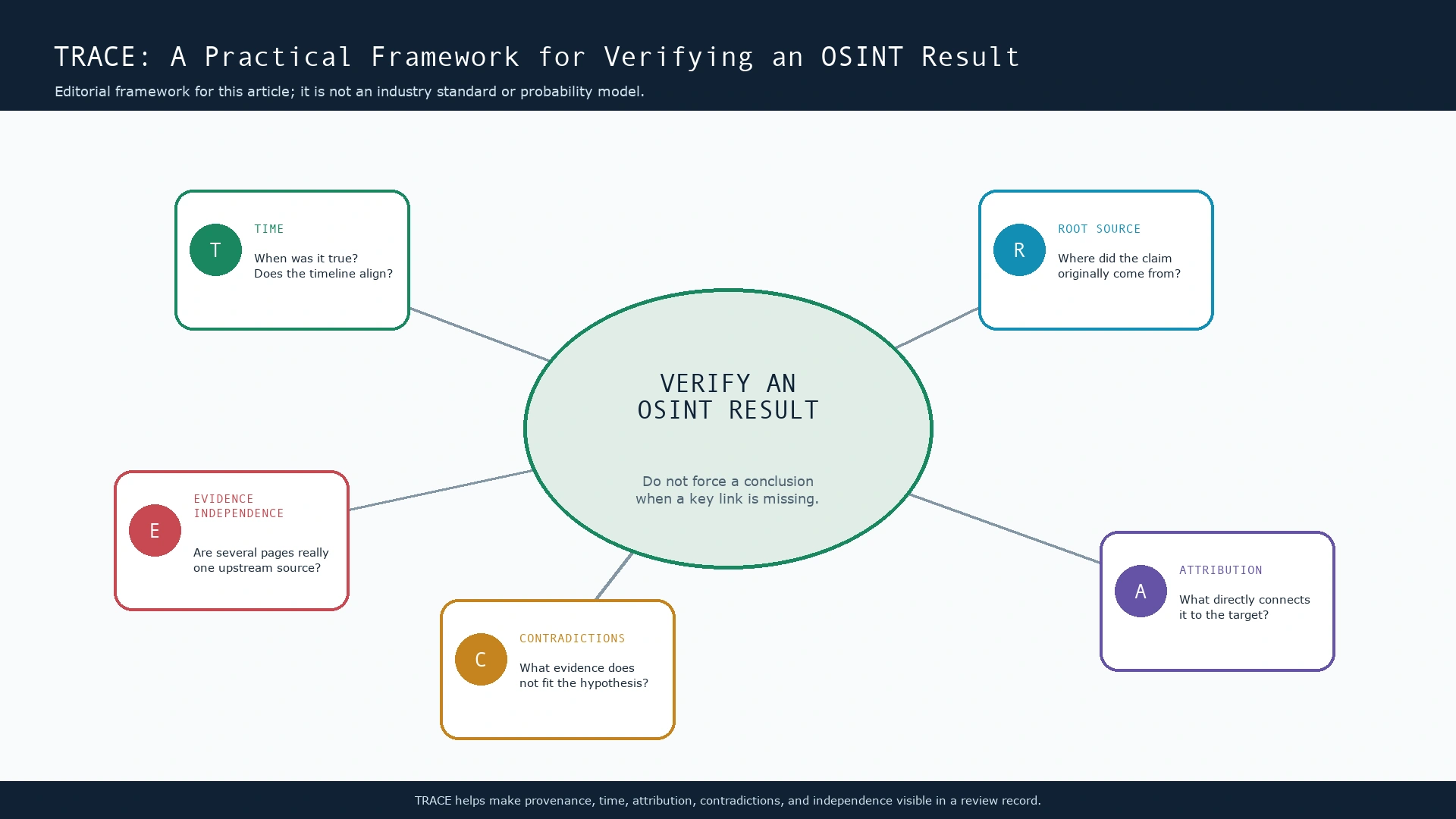
Use TRACE as an editorial checklist, not a scientific score or industry standard: Time—when was this true? Root Source—where did the claim originate? Attribution—what directly connects it to the target? Contradictions—what does not fit? Evidence Independence—are several sources really separate?
A Practical Checklist for Avoiding OSINT False Positives
- Open the original source rather than relying on a card, title, or snippet.
- Separate resource existence from identity ownership.
- Record timestamps and ask when the value was true.
- Inspect redirects, non-specific pages, and soft-404 behavior.
- Keep Blocked, Rate Limited, and Unknown distinct from Not Found.
- Check whether a shared IP, nameserver, MX, or provider is common infrastructure.
- Treat IP location as approximate network context, not a precise address.
- Trace repeated claims back to their root source.
- Look for direct, account-controlled cross-links before merging identities.
- Write contradiction evidence beside supporting evidence.
- Use qualitative confidence language instead of invented percentages.
- For high-impact conclusions, obtain a second, independent review.
Limitations of This Collection
This is not a population-prevalence study. The category chart describes the editorial balance of 50 mechanisms, not the percentage of all OSINT errors in the world. Platform behavior, profiles, routing, access controls, and data availability change over time. The benchmark is a single time-and-network snapshot dated 4 September 2026; it uses 100 non-personal test inputs and 20 frozen public routes, not a sample of all platforms or people. The CMS publication timestamp is 31 July 2026, while this edition transparently cites the later benchmark snapshot as a documented evidence update. Documented entries are included because they are useful recurring mechanisms, not because we personally observed every one on a target.
Frequently Asked Questions About OSINT False Positives
What is an OSINT false positive?
It is a relevant-looking signal that is wrong at detection, attribution, or interpretation. A correct data point can still support a false conclusion.
What is the most common username false positive?
A status-only or title-only route check is especially risky. Open the source and confirm account-specific context before calling it a match.
Does the same username mean the same person?
No. It is a string overlap. Direct self-links and independent, time-aligned context are needed for an attribution claim.
Can a real profile still be a false positive?
Yes. The profile can exist while belonging to a namesake, fan, team, impersonator, or unrelated person.
Can HTTP 200 create a false positive?
Yes. A success response can carry a generic, login, challenge, or soft-404 page. Status must be interpreted with page context.
Does the same IP mean two sites have the same owner?
No. Shared hosting and reverse proxies can place many unrelated domains behind one address.
Can IP geolocation identify an exact location?
Not reliably. Treat it as approximate network context and do not infer a private address.
Are multiple matching sources enough to confirm a result?
Only if they are independent. Several aggregators may reproduce one upstream error or old record.
How do I verify an OSINT finding?
Use TRACE: check time, root source, attribution, contradictions, and evidence independence. Keep Unknown when a critical link is missing.
What is the difference between detection and attribution false positives?
Detection asks whether the resource exists. Attribution asks whether a real resource belongs to the entity being investigated. They require different evidence.
Sources and Further Reading
- SpiderFoot.tools username benchmark summary (4 September 2026)
- Google Search Central: Troubleshoot crawling errors and soft 404s
- IETF RFC 9110: HTTP Semantics
- ICANN: Registration Data Access Protocol (RDAP)
- IANA: Requirements for RDAP Servers Providing Domain Name Data
- Cloudflare: Cloudflare IP addresses
- Cloudflare: Wildcard DNS records
- MaxMind: Understanding IP geolocation accuracy
- Google Search Central: Control your snippets in search results
- Postfix: Virtual domain hosting and catch-all aliases
- NISTIR 8112: Attribute Metadata for Trust Frameworks
- Bellingcat: Editorial Standards & Practices
For a conceptual companion, see Why OSINT Results Can Be Wrong. For the underlying username study, see We Tested 100 Usernames Across 20 Platforms, How Accurate Are Username OSINT Tools?, and How SpiderFoot.tools Finds Username Matches. Read our methodology and privacy information before using any public-data tool.